Dual vz. 61 Suppressed
| Factions | Weapon | Icon | Classes | Ammo |
|---|---|---|---|---|
 VC |
 Dual vz. 61 Suppressed |
 |
Special Loadout Zombies |
40+2 / 160 |
| Damage Base | Headshot × | Chest × | Stomach × | Leg × | Arm × | Reload Speed | |
|---|---|---|---|---|---|---|---|
| Partial | Empty | ||||||
| 31 | ×2.4 = 79.2 | ×1.3 = 42.9 | ×1.2 = 39.6 | ×0.8 = 26.4 | ×0.75 = 24.75 | 4.933 Seconds | 6.5 Seconds |
| Designation | Weapon Type | Fire Modes | Fire Rate | Bullet Spread ° | Range Modifier | Muzzle Velocity | Projectile weight | Weight |
|---|---|---|---|---|---|---|---|---|
| Samopal vzor 61 | Suppressed Dual Machine Pistols |
Auto+Semi | 850 RPM | 11.35° & 4.55° ADS | 0.68 | 320 m/s | 4.5 g (69.4 gr) | 4.56 kg (10.05 lbs) |
| Full name | Caliber | Place of Origin | Date | Manufacturer | Barrel Length | Total Length | Weapon Script Name |
|---|---|---|---|---|---|---|---|
| Škorpion vz. 61 | .32 acp | Czechslovakia | 1961 | Česká zbrojovka Uherský Brod Zastava Arms |
4.5in (115 mm) + Suppressor ~8 in (203.2 mm) |
20.4 in (517 mm) | weapon_dual_vz61e_sog |
The vz. 61 Škorpion is a Czechoslovak selective-fire machine pistol chambered in .32 ACP (7.65×17mm Browning). It was designed as a compact personal-defense weapon for personnel such as vehicle crews and security forces who needed more firepower than a standard pistol. The vz. 61 is best known for its folding stock, controllable burst fire, and a built-in rate-reducing mechanism that helps tame its small, high-cadence action.
HISTORY
Development of the vz. 61 began in 1959 under designer Miroslav Rybář, with the goal of producing a compact automatic weapon that bridged the gap between a sidearm and a full-size submachine gun. Adopted in the early 1960s and produced by Česká zbrojovka at Uherský Brod, the vz. 61 was issued to Czechoslovak security forces and selected military personnel, typically as a defensive arm for roles where carrying a rifle was impractical.
The vz. 61 was exported to various countries during the Cold War and later appeared in a wide range of regional conflicts, often in specialist or security-force roles. Compared with more common assault rifles and submachine guns, documentation of its use in Vietnam-era Southeast Asia is limited, and it is generally considered an uncommon sight relative to standard Soviet and Chinese small arms. Nevertheless, examples in museum collections and reference works highlight the Škorpion’s broader export footprint and long service life beyond its original domestic users.
Sources
- Imperial War Museums – Vz61 Skorpion (collection entry)
- Royal Armouries – Skorpion M61 (collection entry)
- Smithsonian (National Museum of American History) – Skorpion vz61 machine pistol (collection entry)
- American Rifleman – “I Have This Old Gun: Czech Skorpion Pistol”】
-
 vz. 61 Škorpion.
 -
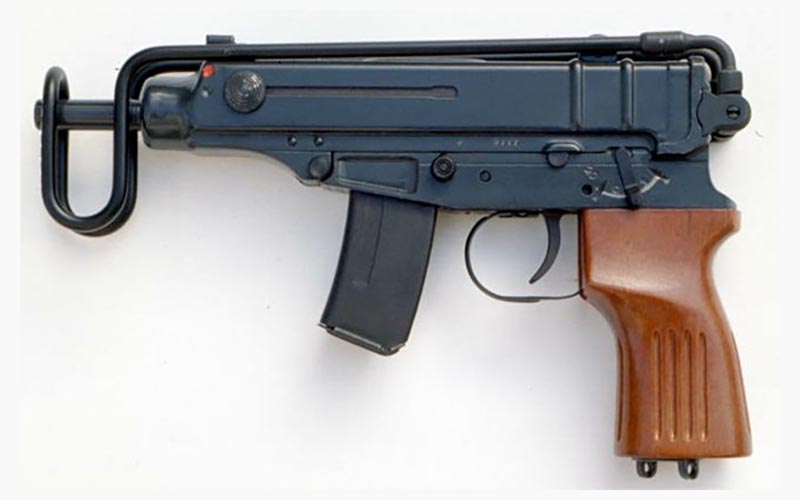 vz. 61 Škorpion, profile view.
 -
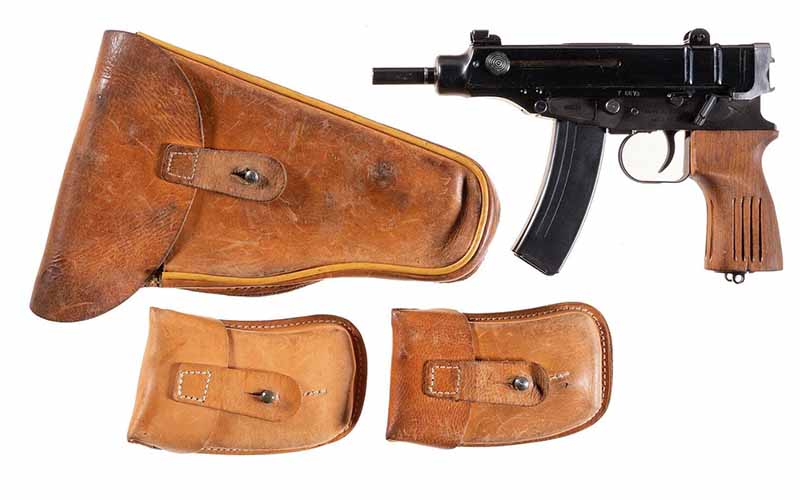 vz. 61 with stock/holster.
 -
 vz. 61 detail view.
 -
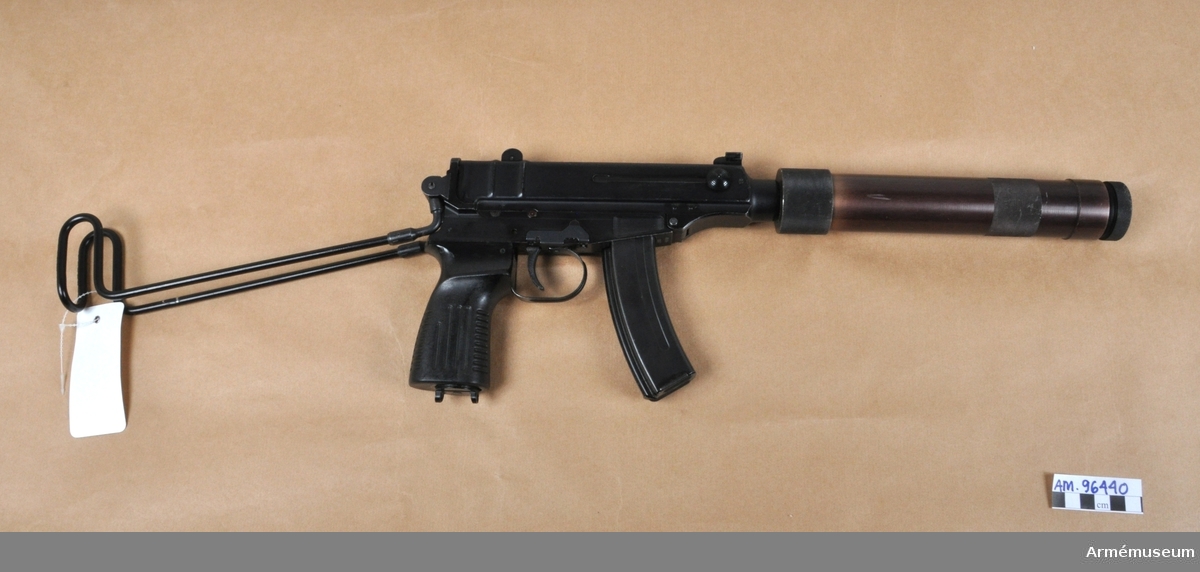 Swedish museum photo of a vz. 61-pattern machine pistol.
 -
 Markings and proof details.


.jpg)
