M1A1 Carbine SOG: Difference between revisions
Skizmophonic (talk | contribs) No edit summary |
Skizmophonic (talk | contribs) No edit summary |
||
| (6 intermediate revisions by the same user not shown) | |||
| Line 1: | Line 1: | ||
[[Category:Weapons]] | |||
[[Category:Weapons of Vietnam]] | |||
{| class="wikitable sortable" style="margin:auto;text-align: center;width:90%" | {| class="wikitable sortable" style="margin:auto;text-align: center;width:90%" | ||
|- | |- | ||
| Line 7: | Line 9: | ||
! rowspan=2 | [[Ammo]] | ! rowspan=2 | [[Ammo]] | ||
|- | |- | ||
|[[File:Flag_us_new.png|50px]]<br><strong>[[US]]</strong>|| [[File:M1c_sog.png|512px]]<br><b> [[M1A1 Carbine SOG]]</b> || [[File:Weapon_m1c_sog.svg|512px]] || [[File:Class_medic.png|50px]] <b>[[Medic]]</b><br> [[File:Class_radioman.png|50px]] <b>[[Radioman]]</b><br> || 15 / 45 | |[[File:Flag_us_new.png|50px]]<br><strong>[[US]]</strong>|| [[File:M1c_sog.png|512px]]<br><b> [[M1A1 Carbine SOG]]</b> || [[File:Weapon_m1c_sog.svg|512px]] || [[File:Class_medic.png|50px]] <b>[[Medic]]</b><br> [[File:Class_radioman.png|50px]] <b>[[Radioman]]</b><br> || 15[[+1]] / 45 | ||
|- | |- | ||
|} | |} | ||
| Line 20: | Line 22: | ||
! rowspan=2 | [[Bayonet]] | ! rowspan=2 | [[Bayonet]] | ||
! rowspan=2 | [[Rifle Grenades]] | ! rowspan=2 | [[Rifle Grenades]] | ||
! colspan=2 | Reload Speed | |||
|- | |- | ||
|36||×2.4 = 86.4||×1.2 = 43.2||×1.15 = 41.4||×0.8 = 28.8||×0.7 = 25.2||NO||NO | ! Partial!! Empty | ||
|- | |||
|36||×2.4 = 86.4||×1.2 = 43.2||×1.15 = 41.4||×0.8 = 28.8||×0.7 = 25.2||NO||NO||2.533 Seconds||3.233 Seconds | |||
|- | |- | ||
|} | |} | ||
| Line 55: | Line 60: | ||
<hr> | |||
'''M1A1 Carbine''' is a U.S. semi-automatic carbine variant of the M1 Carbine family, chambered for the .30 Carbine cartridge. It is a lightweight, gas-operated weapon fed from detachable box magazines, designed to provide more firepower than a pistol for troops who needed a compact arm. It is best known for its folding stock intended for airborne troops and for widespread distribution and continued use in the Vietnam War era by U.S. allies. | |||
==HISTORY== | |||
The M1 Carbine was developed during World War II as a handy defensive weapon for support personnel, and the M1A1 variant was created for airborne forces by fitting a folding stock that improved portability for parachute operations. After World War II and Korea, huge numbers of carbines remained in U.S. inventories and were widely transferred abroad through military assistance programs, making the carbine family one of the most widely issued U.S. small arms of the mid-20th century. | |||
In Vietnam, M1 and [[M2]] carbines were issued early to American advisors and later to a range of U.S. and allied forces, particularly South Vietnamese units, where the carbine’s light weight and controllability were valued. Large quantities were captured and redistributed during the conflict, and some captured carbines were modified locally for compactness. As the war progressed, carbines were increasingly replaced in front-line roles by newer rifles such as the [[M16]], but they remained common in South Vietnamese service and other secondary roles well into the later years of the conflict. | |||
===Sources=== | |||
* [https://www.nps.gov/spar/learn/historyculture/m1-carbine.htm The M1 Carbine | Springfield Armory National Historic Site (NPS)] | |||
* [https://americanhistory.si.edu/collections/object/nmah_417589 U.S. Carbine, Caliber .30, M1A1 | Smithsonian National Museum of American History] | |||
* [https://www.army.mil/article/262209/the_m1_carbine_a_short_history The M1 Carbine: A Short History | U.S. Army] | |||
* [https://vietnamwar.govt.nz/photo/m1-carbine M1 Carbine | VietnamWar.govt.nz (Ministry for Culture and Heritage, New Zealand)] | |||
<hr> | <hr> | ||
<div class="mw-collapsible" style="border:1px solid #ccc; padding:5px; width:100%;"> | |||
<div style="text-align:center; font-weight:bold;">Real-Life Photos</div> | |||
<div class="mw-collapsible-content" style="margin-top:0.5em;"> | |||
<gallery mode="packed" heights="400px"> | |||
File:M1 Carbine Mk I USA Armémuseum noBG new.png|M1/M1A1 Carbine family. | |||
File:Anatomy-m1carbine.png|[https://www.candrsenal.com/product/anatomy-u-s-rifle-m1-carbine-2/ Buy a print of this here] | |||
File:ARVN and US Special Forces.jpg|ARVN soldiers with M1 carbines and U.S. Special Forces with M16s | |||
</gallery> | |||
</div> | |||
</div> | |||
<hr> | |||
{{# | <div class="mw-collapsible" style="border:1px solid #ccc; padding:5px; width:100%;"> | ||
<div style="text-align:center; font-weight:bold;">Videos</div> | |||
| | <div class="mw-collapsible-content" style="margin-top:0.5em;"> | ||
| | {{#ev:youtube|DUppu5IxEY4}} | ||
}} | {{#ev:youtube|10oX4QVpfBw}} | ||
{{#ev:youtube|Dx-8QgkbIiU}} | |||
{{#ev:youtube|FF0qH_zvfdU}} | |||
{{#ev:youtube|klueA4a_eHg}} | |||
{{#ev:youtube|V4Eg3TKkpTY}} | |||
{{#ev:youtube|FOo7sn5cLz0}} | |||
</div> | |||
</div> | |||
Latest revision as of 22:38, 24 February 2026
| Factions | Weapon | Icon | Classes | Ammo |
|---|---|---|---|---|
 US |
 M1A1 Carbine SOG |
 |
 Medic Medic Radioman Radioman |
15+1 / 45 |
| Damage Base | Headshot × | Chest × | Stomach × | Leg × | Arm × | Bayonet | Rifle Grenades | Reload Speed | |
|---|---|---|---|---|---|---|---|---|---|
| Partial | Empty | ||||||||
| 36 | ×2.4 = 86.4 | ×1.2 = 43.2 | ×1.15 = 41.4 | ×0.8 = 28.8 | ×0.7 = 25.2 | NO | NO | 2.533 Seconds | 3.233 Seconds |
| Designation | Weapon Type | Fire Modes | Fire Rate | Bullet Spread ° | Range Modifier | Muzzle Velocity | Projectile weight | Weight |
|---|---|---|---|---|---|---|---|---|
| M1A1 Carbine | Carbine | Semi | 750 RPM | 7.3° & 2.05° ADS | 0.960 | 607 m/s | 7.1 g (109.5 gr) | 2.4 kg (5.29 lbs) |
| Full name | M1 carbine | Place of Origin | Date | Manufacturer | Barrel Length | Total Length | Weapon Script Name |
|---|---|---|---|---|---|---|---|
| Carbine, Caliber .30, M1 | 7.62x33mm | USA | 1942 | Many | 17.75 in (451 mm) | 35.6 in (900 mm) | weapon_m1c_sog |
M1A1 Carbine is a U.S. semi-automatic carbine variant of the M1 Carbine family, chambered for the .30 Carbine cartridge. It is a lightweight, gas-operated weapon fed from detachable box magazines, designed to provide more firepower than a pistol for troops who needed a compact arm. It is best known for its folding stock intended for airborne troops and for widespread distribution and continued use in the Vietnam War era by U.S. allies.
HISTORY
The M1 Carbine was developed during World War II as a handy defensive weapon for support personnel, and the M1A1 variant was created for airborne forces by fitting a folding stock that improved portability for parachute operations. After World War II and Korea, huge numbers of carbines remained in U.S. inventories and were widely transferred abroad through military assistance programs, making the carbine family one of the most widely issued U.S. small arms of the mid-20th century.
In Vietnam, M1 and M2 carbines were issued early to American advisors and later to a range of U.S. and allied forces, particularly South Vietnamese units, where the carbine’s light weight and controllability were valued. Large quantities were captured and redistributed during the conflict, and some captured carbines were modified locally for compactness. As the war progressed, carbines were increasingly replaced in front-line roles by newer rifles such as the M16, but they remained common in South Vietnamese service and other secondary roles well into the later years of the conflict.
Sources
- The M1 Carbine | Springfield Armory National Historic Site (NPS)
- U.S. Carbine, Caliber .30, M1A1 | Smithsonian National Museum of American History
- The M1 Carbine: A Short History | U.S. Army
- M1 Carbine | VietnamWar.govt.nz (Ministry for Culture and Heritage, New Zealand)
-
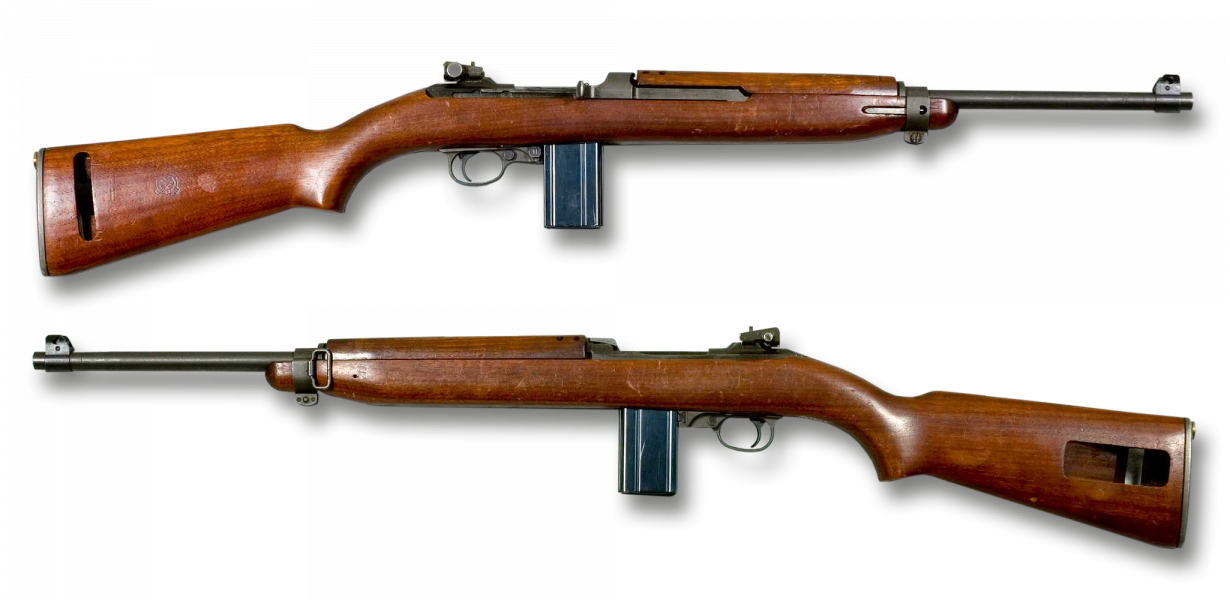 M1/M1A1 Carbine family.
 -
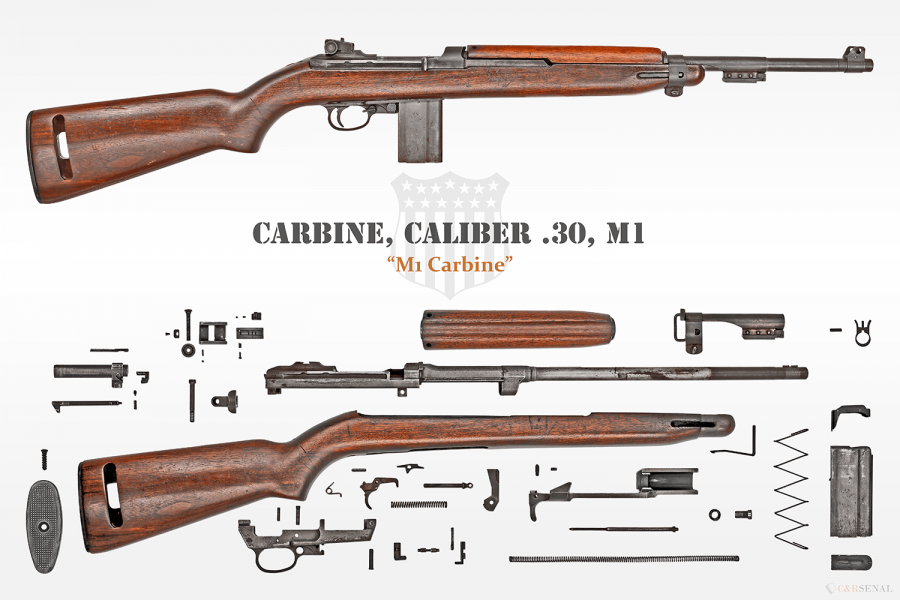
-
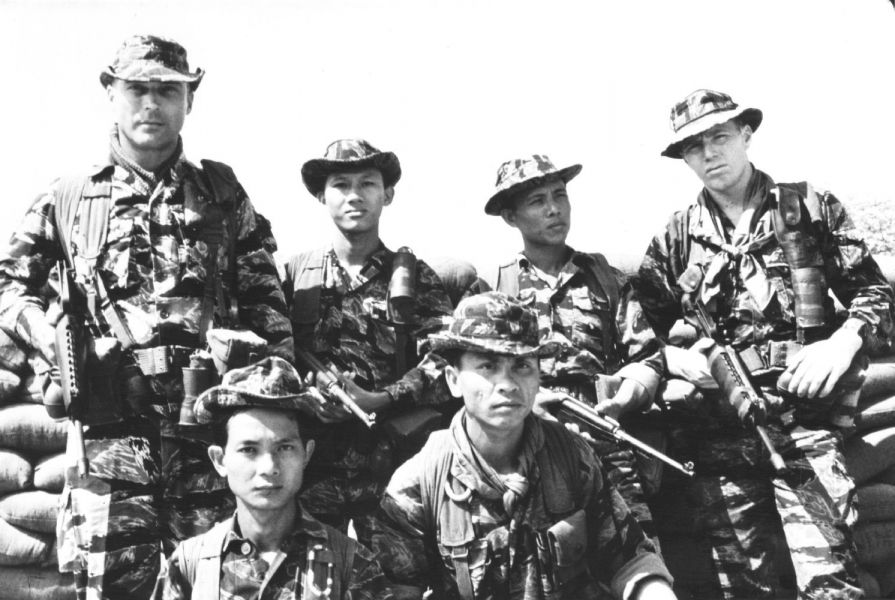 ARVN soldiers with M1 carbines and U.S. Special Forces with M16s


