M26 Frag Grenade
| Factions | Frag Grenades | Icon | Classes | Ammo | Explosion | |
|---|---|---|---|---|---|---|
| Damage | Radius | |||||
 US |
 M26 Frag Grenade |
 |
 Assault Assault Medic Medic Gunner Gunner Sniper Sniper |
1 / 2 | 140 | 350 |
| Designation | Weapon Type | Fire Modes | Throwing Range | Weight |
|---|---|---|---|---|
| M26 | Grenade | 3 Sec + 5 Sec | 25 meters? | 1 kg (2.2 lbs) |
| Full name | Ammo Type | Place of Origin | Date | Manufacturer | Total Length | Weapon Script Name |
|---|---|---|---|---|---|---|
| Grenade, Hand, Fragmentation, M26 | frag grenades | USA | 1952 | Denel Rheinmetall Munitions | 3 7/8 in (99 mm) | weapon_m26 |
The M26 is an American fragmentation hand grenade introduced in the early 1950s as a successor to the World War II-era Mk 2. Its smooth, oval “lemon” body was intended to be easier to carry and throw while still producing effective fragmentation. It is best known as the basis for the M26-family grenades that were widely used by U.S. forces through the Vietnam War era.
HISTORY
The M26 was developed from postwar studies of the Mk 2 grenade, addressing complaints about inconsistent fragmentation and the conspicuous ignition effects of earlier fuzes. The M26 family used a safer and more uniform explosive filler (commonly Composition B) and a fuze design that avoided obvious sparks or smoke during function, improving both handling safety and tactical discretion. The M26 entered U.S. service in the early 1950s and saw combat use in Korea, gradually supplanting the Mk 2 as standard issue in many Army units while large leftover stocks kept Mk 2 grenades in circulation for years.
By the Vietnam War era, improved variants in the M26 family—often referenced through designations such as the M26A1 and related types—were among the primary fragmentation grenades used by U.S. forces in theater. As grenade designs continued to evolve, the M26 family was later replaced by newer U.S. fragmentation grenade patterns that became standard after Vietnam.
Sources
- https://man.fas.org/dod-101/sys/land/m26.htm M26 Fragmentation Hand Grenade | Federation of American Scientists (Military Analysis Network)
- https://www.globalsecurity.org/military/systems/munitions/m26.htm M26 Fragmentation Grenade | GlobalSecurity.org
- https://www.nam.ac.uk/explore/hand-grenade-fragmentation-m26 Hand grenade, fragmentation, M26 | National Army Museum
- https://www.awm.gov.au/collection/C1213531 Hand Grenade, M26 (collection record) | Australian War Memorial
-
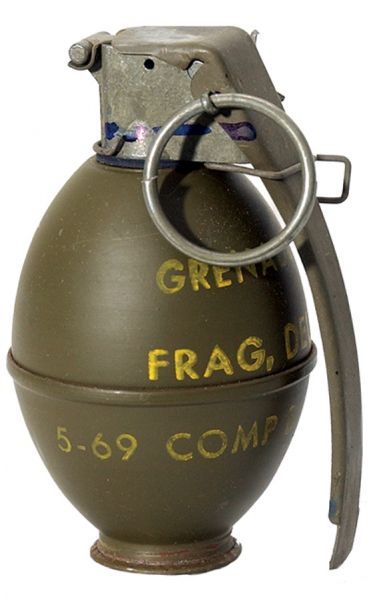 M26 fragmentation hand grenade.
 -
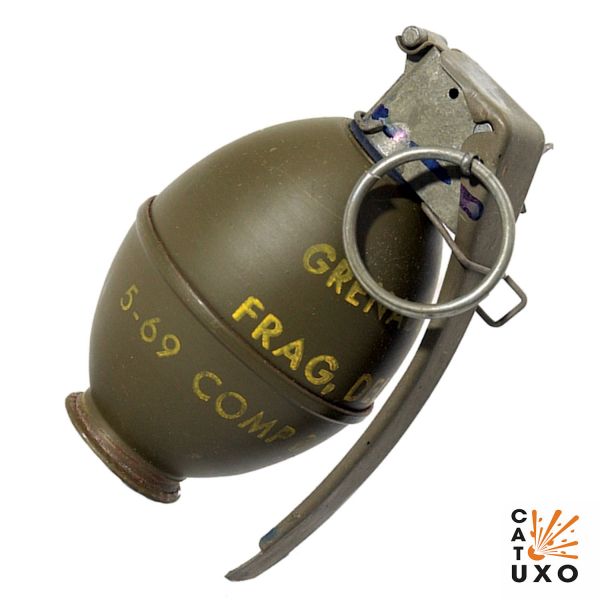 M26-series grenade in field context.
 -
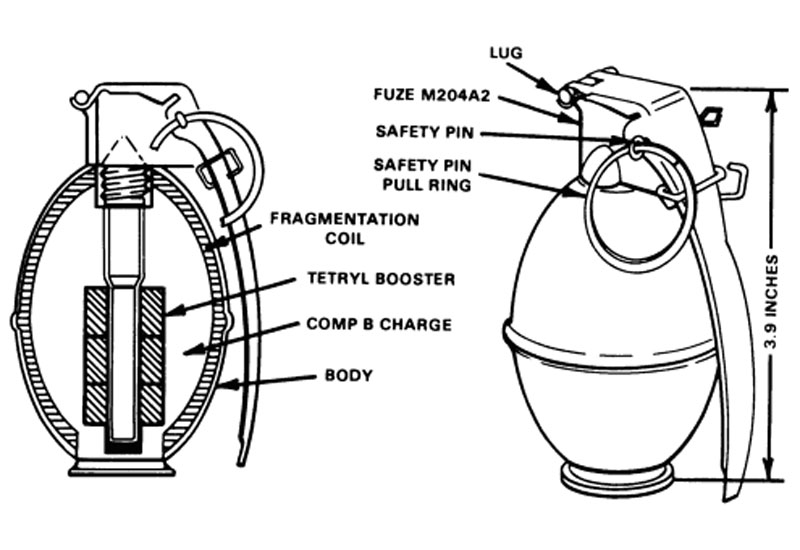 M26 “lemon” grenade profile.


