M16A1
| Factions | Weapon | Icon | Classes | Ammo |
|---|---|---|---|---|
 US |
 M16A1 |
 |
 Assault Assault |
20+1 / 80 |
| Damage Base | Headshot × | Chest × | Stomach × | Leg × | Arm × | Bayonet | Rifle Grenades | Reload Speed | |
|---|---|---|---|---|---|---|---|---|---|
| Partial | Empty | ||||||||
| 37 | ×2.5 = 92.5 | ×1.2 = 44.4 | ×1.15 = 42.55 | ×0.8 = 29.6 | ×0.75 = 27.75 | YES | NO | 2.366 Seconds | 3.166 Seconds |
| Designation | Weapon Type | Fire Modes | Fire Rate | Bullet Spread ° | Range Modifier | Muzzle Velocity | Projectile weight | Weight |
|---|---|---|---|---|---|---|---|---|
| M16A1 | Assault Rifle | Auto+Semi | 750 RPM | 7.17° & 1.15° ADS | 0.955 | 960 m/s | 12.3 g (189.818 gr) | 2.89 kg (6.37 lbs) |
| Full name | Caliber | Place of Origin | Date | Manufacturer | Barrel Length | Total Length | Weapon Script Name |
|---|---|---|---|---|---|---|---|
| Rifle, Caliber 5.56 mm, M16A1 | 5.56mm | USA | 1967 | Colt and Many Other | 20 in (508 mm) | 38.81 in (986 mm) | weapon_m16a1 |
The M16A1 is a U.S. 5.56×45mm assault rifle derived from Eugene Stoner’s AR-15 design. It is best known as the Vietnam War–era standard M16 variant, incorporating changes intended to improve durability and field reliability (notably a forward assist, chrome-lined chamber/bore, and updated maintenance support).
HISTORY
The M16 family grew out of the AR-15 rifle developed at ArmaLite in the late 1950s, and it entered U.S. service during the 1960s as the military pursued a lighter, small-caliber, high-velocity rifle. In the mid-1960s, early M16/XM16E1 rifles were fielded to units deploying to Southeast Asia, and combat use quickly exposed reliability issues tied to ammunition, corrosion, and insufficient cleaning/training support. A U.S. Army review panel in 1968 documented these problems and the corrective actions taken.
The M16A1 incorporated a set of improvements aimed at resolving the Vietnam-era issues, including a forward assist and corrosion-mitigation measures such as chrome-lined chamber/bore, alongside updated maintenance procedures and issued cleaning equipment. The M16A1 became the standard infantry M16 pattern associated with U.S. forces in Vietnam and remained a foundational assault-rifle design for later U.S. service variants.
Sources
- M16A1 rifle | Encyclopædia Britannica
- Report of the M16 Rifle Review Panel (1 June 1968) | U.S. Army (PDF)
- TM 9-1005-249-10 Operator’s Manual for Rifle 5.56-mm M16/M16A1 | Headquarters, Department of the Army (PDF)
- Colt AR-15 M16A1 Automatic Rifle | Smithsonian (NMAH)
- M16A1 Operation Guide (PDF) | Rehost
-
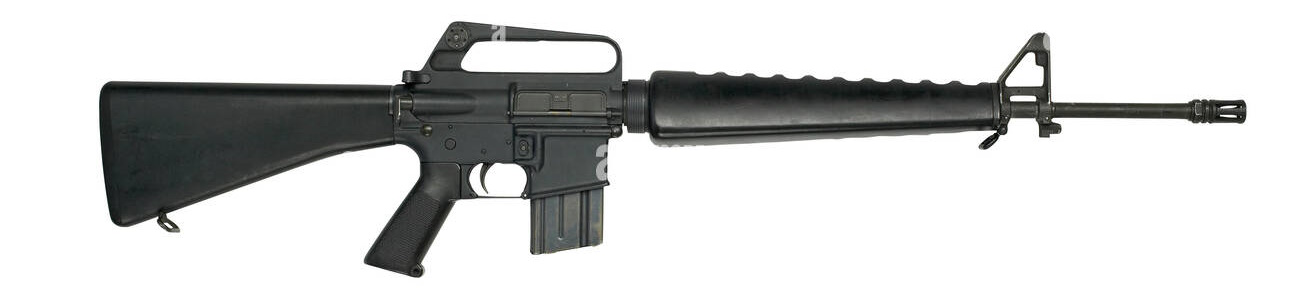 Colt/ArmaLite M16A1.
 -
 U.S. troops with M16-family rifles (Vietnam era).
 -
 Vietnam War–era photo featuring M16-family rifles.
 -
 M16 with a XM148 grenade launcher and Starlight scope.


