NLF Outpost: Difference between revisions
Skizmophonic (talk | contribs) No edit summary |
Skizmophonic (talk | contribs) No edit summary |
||
| (9 intermediate revisions by the same user not shown) | |||
| Line 1: | Line 1: | ||
[[Category:Maps]] | |||
Throughout the Vietnam War the United States Army has made use of long-range reconnaissance patrols (LRRP), well-trained and heavily armed reconnaissance teams. They would go on missions patrolling deep inside the enemy territory gathering intelligence on enemy positions and conducting counterinsurgency operations against the North Vietnamese Army and Việt Cộng. | [[Category:Maps of Vietnam]] | ||
Throughout the [[Vietnam War]] the United States Army has made use of long-range reconnaissance patrols (LRRP), well-trained and heavily armed reconnaissance teams. They would go on missions patrolling deep inside the enemy territory gathering intelligence on enemy positions and conducting counterinsurgency operations against the North Vietnamese Army and [[Việt Cộng]]. | |||
<b><i>Internal name:</i></b> mcv_[[outpost]].bsp | <b><i>Internal name:</i></b> mcv_[[outpost]].bsp | ||
<b><i>Supported gamemodes:</i></b> Capture The Flag, Conquest, Deathmatch, | <b><i>Supported [[gamemodes]]:</i></b> Capture The Flag, Conquest, Deathmatch, FireFight, Gun Game, Gun Game Deathmatch, Last Man Standing, Last Team Standing, Team Deathmatch | ||
| Line 15: | Line 16: | ||
</center> | </center> | ||
=History of LRRPs in Vietnam= | =History of LRRPs in Vietnam= | ||
In December 1965, the 1st Brigade, 101st Airborne Division, formed a LRRP platoon, and by April 1966, the 1st Infantry Division, 25th Infantry Division and each of the four Battalions of the 173rd Airborne Brigade formed LRRP units as well. On 8 July 1966, General William Westmoreland authorized the formation of a (LRRP) unit in each infantry brigade or division in Vietnam. By 1967 formal LRRP companies were organized, most having three platoons, each with five six-man teams equipped with VHF/FM AN/PRC-25 radios. LRRP training was notoriously rigorous and team leaders were often graduates of the U.S. Army's 5th Special Forces Recondo School in Nha Trang, Vietnam. | In December 1965, the 1st Brigade, 101st Airborne Division, formed a LRRP platoon, and by April 1966, the 1st Infantry Division, 25th Infantry Division and each of the four Battalions of the 173rd Airborne Brigade formed LRRP units as well. On 8 July 1966, General William Westmoreland authorized the formation of a (LRRP) unit in each infantry brigade or division in [[Vietnam]]. By 1967 formal LRRP companies were organized, most having three platoons, each with five six-man teams equipped with VHF/FM AN/PRC-25 radios. LRRP training was notoriously rigorous and team leaders were often graduates of the [[U.S. Army]]'s 5th Special Forces Recondo School in Nha Trang, Vietnam. | ||
Tiger Force was the nickname of an infamous long-range reconnaissance patrol unit | Tiger Force was the nickname of an infamous long-range reconnaissance patrol unit of the 1st Battalion (Airborne), 327th Infantry Regiment, 1st Brigade (Separate), 101st Airborne Division, which fought in the [[Vietnam War]], and was responsible for counterinsurgency operations against the North Vietnamese People's Army of Vietnam ([[PAVN]]) and [[Việt Cộng]]. | ||
The platoon-sized unit, approximately 45 paratroopers, was founded by Colonel David Hackworth in November 1965 to "outguerrilla the guerrillas". Tiger Force (Recon) 1/327th was a highly decorated small unit in Vietnam, and paid for its reputation with heavy casualties. In October 1968, Tiger Force's parent battalion was awarded the Presidential Unit Citation by President Lyndon B. Johnson, which included a mention of Tiger Force's service at Đắk Tô in June 1966. | The platoon-sized unit, approximately 45 paratroopers, was founded by Colonel David Hackworth in November 1965 to "outguerrilla the guerrillas". Tiger Force (Recon) 1/327th was a highly decorated small unit in Vietnam, and paid for its reputation with heavy casualties. In October 1968, Tiger Force's parent battalion was awarded the Presidential Unit Citation by President Lyndon B. Johnson, which included a mention of Tiger Force's service at Đắk Tô in June 1966. | ||
| Line 25: | Line 25: | ||
Since satellite communications were a thing of the future, one of the most daring long-range penetration operations of the war was launched by members of Company E, 52nd Infantry (LRP) of the 1st Air Cavalry Division, against the PAVN when they seized "Signal Hill" the name attributed to the peak of Dong Re Lao Mountain, a densely forested 4,879 feet (1,487 m) mountain, midway in A Shau Valley, so its 1st and 3rd Brigades, who would be fighting behind a wall of mountains, could communicate with Camp Evans near the coast or with approaching aircraft. | Since satellite communications were a thing of the future, one of the most daring long-range penetration operations of the war was launched by members of Company E, 52nd Infantry (LRP) of the 1st Air Cavalry Division, against the PAVN when they seized "Signal Hill" the name attributed to the peak of Dong Re Lao Mountain, a densely forested 4,879 feet (1,487 m) mountain, midway in A Shau Valley, so its 1st and 3rd Brigades, who would be fighting behind a wall of mountains, could communicate with Camp Evans near the coast or with approaching aircraft. | ||
The US Marine Corps also performed long-range reconnaissance missions typically assigned to Marine Recon, especially Force Recon at the corps-level (i.e., Marine Expeditionary Force (MEF)) level, as opposed to the Battalion Recon units answering to battalion commanders. Marine Recon teams typically were twice as large as Army LRRPs and were more heavily armed, however, sacrificing a degree of stealth. In addition, the Marines did not employ indigenous Montagnards as front and rear scouts as Army LRRPs and Special Forces teams did which proved invaluable in confusing the enemy if contact was made. The tactical employment of LRRPs was later evaluated to be generally used far too dangerously by commanders, who were pleased by the kill ratios of LRRPs teams (reported as high as 400 enemy troops for every LRRP killed). Writes one commentator: "During the course of the war Lurps conducted around 23,000 long-range patrols, of this amount two-thirds resulted in enemy sightings." LRRPs also accounted for approximately 10,000 enemy KIA through ambushes, air strikes, and artillery. | The US Marine Corps also performed long-range reconnaissance missions typically assigned to Marine Recon, especially Force Recon at the corps-level (i.e., Marine Expeditionary Force (MEF)) level, as opposed to the Battalion Recon units answering to battalion commanders. Marine Recon teams typically were twice as large as Army LRRPs and were more heavily armed, however, sacrificing a degree of stealth. In addition, the Marines did not employ indigenous Montagnards as front and rear scouts as Army LRRPs and Special Forces teams did which proved invaluable in confusing the enemy if contact was made. The tactical employment of LRRPs was later evaluated to be generally used far too dangerously by commanders, who were pleased by the kill ratios of LRRPs teams (reported as high as 400 enemy troops for every LRRP killed). Writes one commentator: "During the course of the war Lurps conducted around 23,000 long-range patrols, of this amount two-thirds resulted in enemy sightings." LRRPs also accounted for approximately 10,000 enemy KIA through ambushes, air strikes, and artillery. | ||
As the Vietnam War matured, I Field Force LRRPs widened their area of operation to include I Corps and II Corps, and II Field Force LRRPs respectively included III Corps and IV Corps. | As the Vietnam War matured, I Field Force LRRPs widened their area of operation to include I Corps and II Corps, and II Field Force LRRPs respectively included III Corps and IV Corps. | ||
<br>[https://en.wikipedia.org/wiki/Long-range_reconnaissance_patrol SOURCE] | |||
<hr> | <hr> | ||
Latest revision as of 08:06, 5 November 2024
Throughout the Vietnam War the United States Army has made use of long-range reconnaissance patrols (LRRP), well-trained and heavily armed reconnaissance teams. They would go on missions patrolling deep inside the enemy territory gathering intelligence on enemy positions and conducting counterinsurgency operations against the North Vietnamese Army and Việt Cộng.
Internal name: mcv_outpost.bsp
Supported gamemodes: Capture The Flag, Conquest, Deathmatch, FireFight, Gun Game, Gun Game Deathmatch, Last Man Standing, Last Team Standing, Team Deathmatch
-
 Mapicon
 -
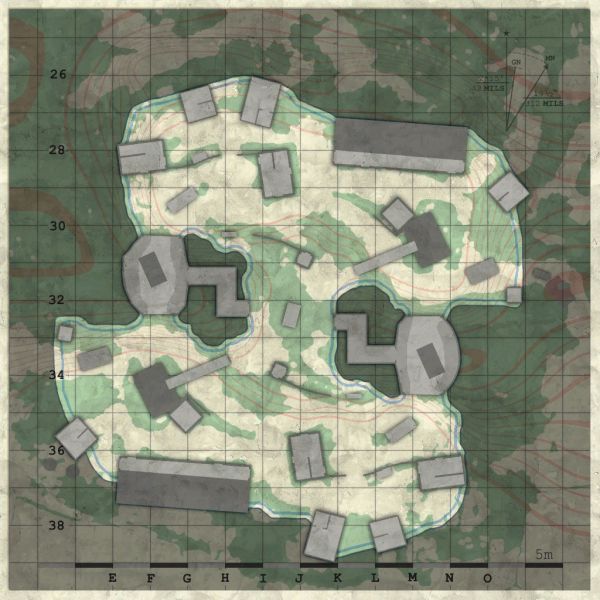 Minimap


History of LRRPs in Vietnam
In December 1965, the 1st Brigade, 101st Airborne Division, formed a LRRP platoon, and by April 1966, the 1st Infantry Division, 25th Infantry Division and each of the four Battalions of the 173rd Airborne Brigade formed LRRP units as well. On 8 July 1966, General William Westmoreland authorized the formation of a (LRRP) unit in each infantry brigade or division in Vietnam. By 1967 formal LRRP companies were organized, most having three platoons, each with five six-man teams equipped with VHF/FM AN/PRC-25 radios. LRRP training was notoriously rigorous and team leaders were often graduates of the U.S. Army's 5th Special Forces Recondo School in Nha Trang, Vietnam.
Tiger Force was the nickname of an infamous long-range reconnaissance patrol unit of the 1st Battalion (Airborne), 327th Infantry Regiment, 1st Brigade (Separate), 101st Airborne Division, which fought in the Vietnam War, and was responsible for counterinsurgency operations against the North Vietnamese People's Army of Vietnam (PAVN) and Việt Cộng.
The platoon-sized unit, approximately 45 paratroopers, was founded by Colonel David Hackworth in November 1965 to "outguerrilla the guerrillas". Tiger Force (Recon) 1/327th was a highly decorated small unit in Vietnam, and paid for its reputation with heavy casualties. In October 1968, Tiger Force's parent battalion was awarded the Presidential Unit Citation by President Lyndon B. Johnson, which included a mention of Tiger Force's service at Đắk Tô in June 1966.
Since satellite communications were a thing of the future, one of the most daring long-range penetration operations of the war was launched by members of Company E, 52nd Infantry (LRP) of the 1st Air Cavalry Division, against the PAVN when they seized "Signal Hill" the name attributed to the peak of Dong Re Lao Mountain, a densely forested 4,879 feet (1,487 m) mountain, midway in A Shau Valley, so its 1st and 3rd Brigades, who would be fighting behind a wall of mountains, could communicate with Camp Evans near the coast or with approaching aircraft.
The US Marine Corps also performed long-range reconnaissance missions typically assigned to Marine Recon, especially Force Recon at the corps-level (i.e., Marine Expeditionary Force (MEF)) level, as opposed to the Battalion Recon units answering to battalion commanders. Marine Recon teams typically were twice as large as Army LRRPs and were more heavily armed, however, sacrificing a degree of stealth. In addition, the Marines did not employ indigenous Montagnards as front and rear scouts as Army LRRPs and Special Forces teams did which proved invaluable in confusing the enemy if contact was made. The tactical employment of LRRPs was later evaluated to be generally used far too dangerously by commanders, who were pleased by the kill ratios of LRRPs teams (reported as high as 400 enemy troops for every LRRP killed). Writes one commentator: "During the course of the war Lurps conducted around 23,000 long-range patrols, of this amount two-thirds resulted in enemy sightings." LRRPs also accounted for approximately 10,000 enemy KIA through ambushes, air strikes, and artillery.
As the Vietnam War matured, I Field Force LRRPs widened their area of operation to include I Corps and II Corps, and II Field Force LRRPs respectively included III Corps and IV Corps.
SOURCE