Mosin-Nagant M91/30
| Factions | Weapon | Icon | Classes | Ammo |
|---|---|---|---|---|
 VC |
 Mosin-Nagant M91/30 |
 |
 Assault Assault Sniper Sniper |
5 / 20 |
| Damage Base | Headshot × | Chest × | Stomach × | Leg × | Arm × | Bayonet | Rifle Grenades | Reload Speed |
|---|---|---|---|---|---|---|---|---|
| 65 | ×2.4 = 156 | ×2.15 = 139.75 | ×1.95 = 126.75 | ×1.15 = 74.75 | ×1.15 = 74.75 | YES | YES | 3.733 Seconds |
| Designation | Weapon Type | Fire Modes | Fire Rate | Bullet Spread ° | Range Modifier | Muzzle Velocity | Projectile weight | Weight |
|---|---|---|---|---|---|---|---|---|
| M91/30 | Bolt Action | Single Shot | 45 RPM | 7.7° & 0.05° ADS | 0.985 | 865m/s | 9 g (138.89 gr) | 3.4 kg (7.5 lbs) |
| Full name | Caliber | Place of Origin | Date | Manufacturer | Barrel Length | Total Length | Weapon Script Name |
|---|---|---|---|---|---|---|---|
| 3-line rifle M1891 | 7.62x54mm | Russia | 1930 | Tula Many others |
29 in (730 mm) | 48.5 in (1,232 mm) | weapon_m91 |
Mosin–Nagant M91/30 is a Soviet bolt-action infantry rifle chambered for the 7.62×54mmR cartridge. It uses a five-round internal magazine loaded by stripper clips and the Mosin–Nagant action. It is best known as the standard Soviet rifle of World War II and as one of the most widely produced military bolt-action rifles, remaining in service or reserve stocks long after its introduction.
HISTORY
The Mosin–Nagant family originated as Russia’s Model 1891 “3-line rifle,” developed in the late 19th century and adopted by the Russian Empire. The M91/30 was a Soviet modernization adopted in 1930 that standardized updated sights and production features while retaining the same basic action and 7.62×54mmR cartridge, enabling mass manufacture on an enormous scale. It became the primary Soviet infantry rifle through World War II and also served as the basis for several specialized variants, including sniper rifles fitted with optics.
After World War II, vast numbers of Mosin–Nagant rifles remained in Soviet and allied stockpiles and entered global circulation through military aid, transfers, and conflict capture. In Southeast Asia, Mosin–Nagant rifles could appear among older-pattern small arms supplied to communist forces or retained in secondary roles, especially in early phases before assault rifles became dominant. In Vietnam-era inventories, they were typically encountered alongside a wide mix of weapons from multiple sources and periods.
Sources
- Mosin–Nagant M1891/30 rifle | Imperial War Museums
- Rifle, Mosin-Nagant, Model 1891/30 | Royal Armouries
- Mosin-Nagant M91/30 | Forgotten Weapons
- Sources of Military Equipment to Viet Cong and North Vietnamese Forces (arms supply context) | CIA Reading Room
-
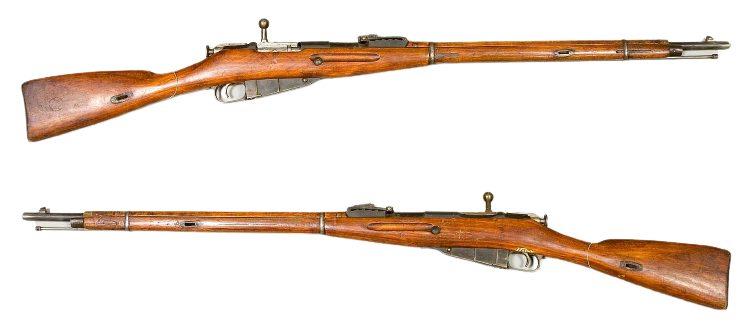 Mosin–Nagant M91/30 rifle.
 -


