TUL-1
| Factions | Weapon | Icon | Classes | Ammo |
|---|---|---|---|---|
 VC |
 TUL-1 |
 |
 Gunner Gunner |
40+1 / 120 |
| Damage Base | Headshot × | Chest × | Stomach × | Leg × | Arm × | Bayonet | Rifle Grenades | Reload Speed | |
|---|---|---|---|---|---|---|---|---|---|
| Partial | Empty | ||||||||
| 41 | ×2.52 = 103.32 | ×1.2 = 49.2 | ×1.15 = 47.15 | ×0.8 = 32.8 | × = 30.75 | NO | NO | 2.433 Seconds | 3.2 Seconds |
| Designation | Weapon Type | Fire Modes | Fire Rate | Bullet Spread ° | Bipod Bullet Spread ° | Range Modifier | Muzzle Velocity | Projectile weight | Weight |
|---|---|---|---|---|---|---|---|---|---|
| TUL-1 | LMG | Auto+Semi | 600 RPM | 7.47° & 1.87° ADS | 2.47° & 1.02° ADS | 0.940 | 745 m/s | 7.9 g (121.9 gr) | 4.8 kg (10.6 lbs) |
| Full name | Caliber | Place of Origin | Date | Manufacturer | Barrel Length | Total Length | Weapon Script Name |
|---|---|---|---|---|---|---|---|
| TUL-1 | 7.62x39mm | North Vietnam | 1970 | Vietnam Workshops | 23.22 in (590 mm) | 40.94in (1,040 mm) | weapon_tul1 |
The TUL-1 is a Vietnamese light machine gun chambered in 7.62×39mm (M43) and built as a locally produced squad automatic weapon. It was developed by adapting Type 56/QBZ-56-pattern components to approximate the role of the RPK when purpose-built RPKs were in short supply. The TUL-1 is best known as a wartime “self-reliance” design associated with Vietnamese domestic arms production during the late Vietnam War period.
HISTORY
Vietnamese military industry pursued the TUL-1 in the late 1960s as part of broader efforts to design and produce small arms domestically for the war effort. Contemporary Vietnamese reporting describes the weapon as researched from the late 1960s based on the Soviet RPK concept, with Z111 organizing production on existing AK-type manufacturing lines; a TUL-1 marked example is described as being completed in late 1969, followed by production runs in the early 1970s. The name “TUL” is commonly explained as short for “Tự Lực” (self-reliance), reflecting the intent to sustain supply despite wartime constraints.
In configuration, the TUL-1 combined a Type 56-pattern receiver with features intended to support automatic fire at squad level, including an RPK-style stock and a bipod, while feeding from 30-round AK-pattern magazines (with some reports of rarer 40-round magazines). Reporting on the design notes a lighter stamped receiver compared to the RPK and performance compromises versus purpose-built light machine guns, but with improved sustained-fire capability compared to a standard assault rifle. It was issued to North Vietnamese forces during the conflict and later declined in importance as more standard light machine guns became available.
Sources
- Báo Tiền Phong – Khám phá súng trung liên TUL-1 “made in Vietnam”
- Báo Nhân Dân – Phát triển công nghiệp quốc phòng hiện đại, lưỡng dụng (mentions trung liên TUL-1)
- Army Recognition – TUL-1 light machine gun still in use in Vietnamese army
-
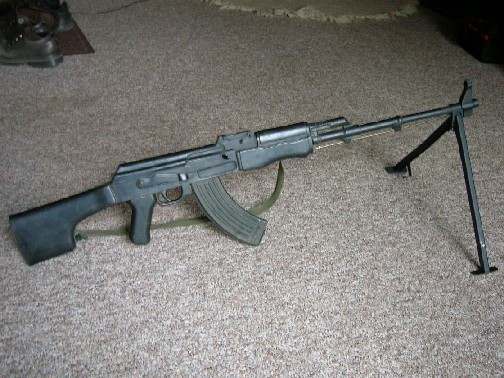 TUL-1 light machine gun.
 -
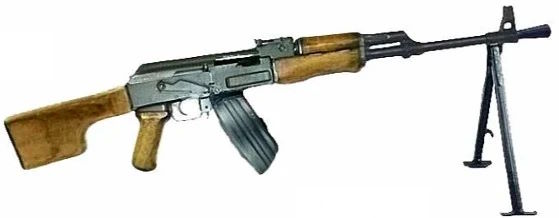 TUL-1 configuration based on Type 56-pattern components.
 -
 TUL-1 with bipod and AK-pattern magazine.
 -
 TUL-1 in service/training context.


