AVT-40
| Factions | Weapon | Icon | Classes | Ammo |
|---|---|---|---|---|
 VC |
 AVT-40 |
 |
 Assault Assault |
15+1 / 75 |
| Damage Base | Headshot × | Chest × | Stomach × | Leg × | Arm × | Bayonet | Rifle Grenades | Reload Speed | |
|---|---|---|---|---|---|---|---|---|---|
| Partial | Empty | ||||||||
| 44 | ×2.4 = 105.6 | ×1.28 = 56.32 | ×1.23 = 54.12 | ×0.8 = 35.2 | ×0.7 = 30.8 | YES | NO | 2.733 Seconds | 3.5 Seconds |
| Designation | Weapon Type | Fire Modes | Fire Rate | Bullet Spread ° | Range Modifier | Muzzle Velocity | Projectile weight | Weight |
|---|---|---|---|---|---|---|---|---|
| AVT-40 | Battle Rifle | Auto+Semi | 700 RPM | 7.5° & 1.25° ADS | 0.945 | 830 m/s | 9 g (138.89 gr) | 3.85 kg (8.48 lbs) |
| Full name | Caliber | Place of Origin | Date | Manufacturer | Barrel Length | Total Length | Weapon Script Name |
|---|---|---|---|---|---|---|---|
| AVT-40 | 7.62x54mm | Soviet Union | 1942 | Arm | 24.6 in (625 mm) | 48.3 in (1,226 mm) | weapon_svt40 |
AVT-40 is a Soviet select-fire rifle derived from the SVT-40, chambered for the 7.62×54mmR cartridge. It uses a gas-operated action and is fed from a detachable 10-round box magazine. It is best known as a wartime attempt to give the SVT platform fully automatic capability, which proved difficult to control and hard on the rifle’s service life.
HISTORY
The AVT-40 (Avtomaticheskaya Vintovka Tokareva) was introduced by the Soviet Union during World War II as a modification of the SVT-40 to provide both semi-automatic and automatic fire. While the SVT family already offered higher practical rate of fire than bolt-action rifles, wartime pressure for increased close-range firepower led to authorization of a select-fire variant. In service, the AVT-40’s automatic mode was widely described as hard to control due to recoil in the full-power 7.62×54mmR cartridge, and sustained automatic fire accelerated wear and increased the risk of parts breakage; as a result, its use was limited and the concept was short-lived compared with other Soviet small arms.
After World War II, SVT-family rifles—including select-fire AVT examples in limited numbers—entered global surplus channels and appeared in later conflicts through capture and military aid. In the Vietnam War era, Soviet-bloc weapons were supplied to communist forces in Indochina through a mix of direct aid and redistribution, and Tokarev self-loading rifles are documented among the older-pattern arms that could turn up alongside newer assault rifles and machine guns. In Vietnamese hands, the AVT-40 would most commonly be used as a semi-automatic rifle due to recoil and durability concerns when fired on automatic.
Sources
- Tokarev SVT-40 self-loading rifle (context for AVT family) | Imperial War Museums
- SVT-40 (Tokarev Self-Loading Rifle) | Forgotten Weapons
- Soviet SVT-40 Tokarev Rifle (historical/technical background for the platform) | RifleShooter
- Communist Aid to North Vietnam (arms aid context) | CIA CREST
-
 AVT-40 select-fire Tokarev rifle.
 -
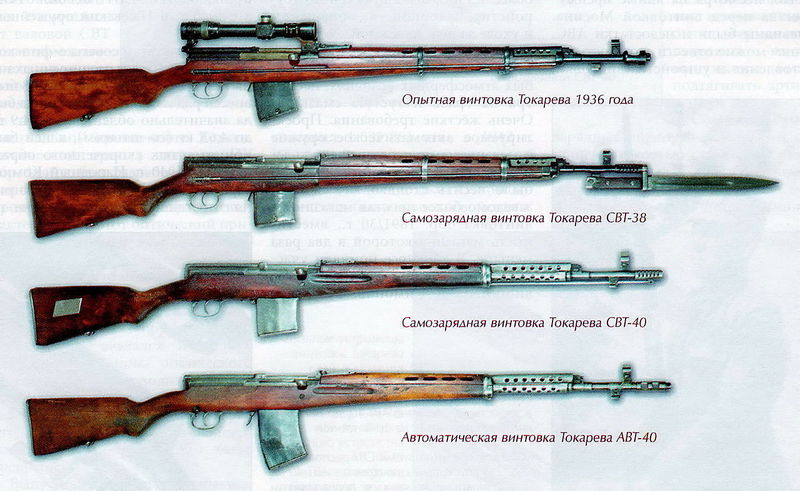 AVT-40 / SVT-family rifle in 7.62×54mmR.
 -


