MAS-49
| Factions | Weapon | Icon | Classes | Ammo |
|---|---|---|---|---|
 VC |
 MAS-49 |
 |
 Assault Assault |
10+1 / 50 |
| Damage Base | Headshot × | Chest × | Stomach × | Leg × | Arm × | Bayonet | Rifle Grenades | Reload Speed | |
|---|---|---|---|---|---|---|---|---|---|
| Partial | Empty | ||||||||
| 52 | ×2.45 = 127.4 | ×1.2 = 62.4 | ×1.15 = 59.8 | ×0.8 = 41.6 | ×0.7 = 36.4 | YES | YES | 2.7 Seconds | 3.366 Seconds |
| Designation | Weapon Type | Fire Modes | Fire Rate | Bullet Spread ° | Range Modifier | Muzzle Velocity | Projectile weight | Weight |
|---|---|---|---|---|---|---|---|---|
| MAS-49 | Battle Rifle | Semi | 50 RPM | 6.55° & 1.35° ADS | 0.965 | 820 m/s | 9 g (138.89 gr) | 4.7 kg (10.4 lbs) |
| Full name | Caliber | Place of Origin | Date | Manufacturer | Barrel Length | Total Length | Weapon Script Name |
|---|---|---|---|---|---|---|---|
| Fusil semi-automatique 7 mm 5 M. 49 | 7.5×54mm French | France | 1949 | Manufacture d'armes de Saint-Étienne | 22.8 in (580 mm) | 43.35 in (1100 mm) | weapon_mas49 |
MAS-49 is a French semi-automatic service rifle chambered for the 7.5×54mm French cartridge. It is a gas-operated rifle fed from a 10-round detachable magazine, and it was designed to modernize French infantry firepower after World War II. It is best known for its reliability in field conditions and for its receiver-side optics mounting rail intended for a dedicated military scope.
HISTORY
The MAS-49 was developed from a line of French self-loading rifle prototypes and postwar trial rifles, entering production in the early 1950s as France standardized a new semi-automatic service rifle. It was manufactured at Manufacture d’armes de Saint-Étienne (MAS) and featured built-in provisions for rifle grenades and optics mounting, reflecting French doctrine that emphasized versatile infantry rifles capable of launching grenades and supporting markssmanship.
The MAS-49 appeared in French service during the final phase of the First Indochina War and remained in use through the 1950s, before the shorter and lighter MAS-49/56 became the dominant follow-on pattern in later decades. While the MAS-49 itself was produced in more limited numbers than its successor, the family’s reputation for ruggedness and practical accuracy helped keep MAS-49/56 rifles in widespread French service into the FAMAS era.
Sources
- MAS M1949 rifle | Imperial War Museums
- MAS 49 Rifle | Forgotten Weapons
- MAS 49: A Universal Service Rifle | Forgotten Weapons
- Guide Technique: Fusil semi-automatique de 7,5 mm modèle 1949-56 (MAT 1032) | Ministère de la Défense (via Forgotten Weapons)
-
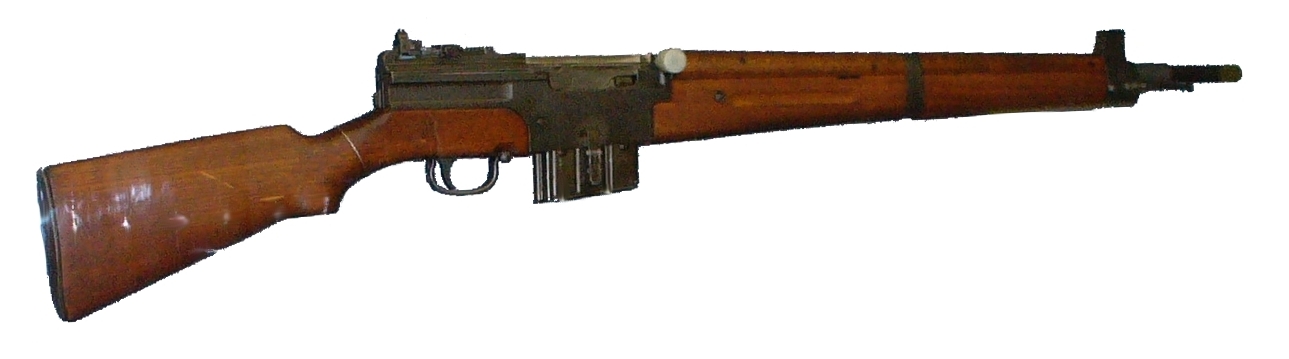 MAS-49 semi-automatic rifle.
 -
 Comparison of the MAS-44, MAS-49, and MAS-49/56.

