H&R T223
| Factions | Weapon | Icon | Classes | Ammo |
|---|---|---|---|---|
 US |
 H&R T223 |
 |
 Assault Assault |
25+1 / 75 |
| Damage Base | Headshot × | Chest × | Stomach × | Leg × | Arm × | Bayonet | Rifle Grenades | Reload Speed | |
|---|---|---|---|---|---|---|---|---|---|
| Partial | Empty | ||||||||
| 38 | ×2.5 = 95 | ×1.2 = 45.6 | ×1.15 = 43.7 | × = 30.4 | ×0.75 = 28.5 | NO | NO | 3.2 Seconds | 4.76 Seconds |
| Designation | Weapon Type | Fire Modes | Fire Rate | Bullet Spread ° | Range Modifier | Muzzle Velocity | Projectile weight | Weight |
|---|---|---|---|---|---|---|---|---|
| H&R T223 | Assault Rifle | Auto+Semi+Burst | 650 RPM | 7.35° & 1.25° ADS | 0.945 | 960 m/s | 12.3 g (189.818 gr) | 2.89 kg (6.37 lbs) |
| Full name | Caliber | Place of Origin | Date | Manufacturer | Barrel Length | Total Length | Weapon Script Name |
|---|---|---|---|---|---|---|---|
| 5.56mm Rifle T223 | 5.56mm | USA | 1965 | Harrington & Richardson Arms Co. | 15.7 in (398.78 mm) | 37 in (939.8 mm) | weapon_t223 |
H&R T223 is a selective-fire rifle chambered in 5.56×45mm (.223). It is best known as a rare, U.S.-made licensed copy of the Heckler & Koch HK33 that was evaluated in limited numbers rather than adopted for general issue.
HISTORY
The T223 was produced by Harrington & Richardson (H&R) in the United States under license from Heckler & Koch as a 5.56×45mm version of the HK33 pattern, using the roller-delayed operating system. A U.S. Army “Preliminary Operating and Maintenance Manual” for the “5.56 mm Rifle T223” dated June 1965 documents the weapon in service test/evaluation form, indicating it was being handled as an official program item rather than a standard-issue rifle. Surviving museum examples and collection records place the rifle in the Vietnam War era (commonly dated around 1968), but it did not progress into widespread U.S. adoption.
In the Vietnam War period, the T223 is generally described as an experimental or trial rifle used in very small numbers by U.S. personnel, compared to standardized 5.56mm service rifles. Contemporary discussion of the manual notes magazine options beyond the then-common 20-round capacity (including 40-round magazines), which was an attractive feature early in the war; however, the T223’s overall footprint in theater remained niche.
Sources
- 5.56 mm Rifle T223 — Preliminary Operating and Maintenance Manual (June 1965) | U.S. Army (hosted by Forgotten Weapons)
- H&R T223 manual | Forgotten Weapons
- H&R T 223 Rifle (Object Record) | Smithsonian National Museum of American History
- Rifle, Assault (Harrington & Richardson T223) | Kentucky Historical Society
-
 H&R T223 (overall view)
 -
 Receiver/detail view
 -
 H&R T223 with magazine
 -
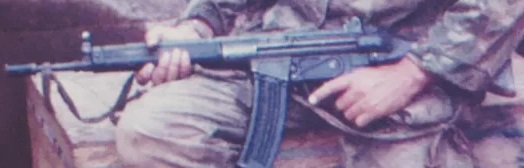 Profile view


