Stoner 63A Bren
| Factions | Weapon | Icon | Classes | Ammo |
|---|---|---|---|---|
 US |
 Stoner 63A Bren |
 |
 Gunner Gunner |
30 / 120 |
| Damage Base | Headshot × | Chest × | Stomach × | Leg × | Arm × | Bayonet | Rifle Grenades | Reload Speed | |
|---|---|---|---|---|---|---|---|---|---|
| Partial | Empty | ||||||||
| 33 | ×2.5 = 82.5 | ×1.2 = 39.6 | ×1.15 = 37.95 | ×0.8 = 26.4 | ×0.75 = 19.8 | NO | NO | 3.5 Seconds | 4.166 Seconds |
| Designation | Weapon Type | Fire Modes | Fire Rate | Bullet Spread ° | Bipod Bullet Spread ° | Range Modifier | Muzzle Velocity | Projectile weight | Weight |
|---|---|---|---|---|---|---|---|---|---|
| ? | LMGs | Auto | 825 RPM | 9.43° & 2.62° ADS | 2.21° & 0.71° ADS | 0.935 | 991 m/s | 12.3 g (189.8 gr) | 8.62 kg (19 lbs) |
| Full name | Caliber | Place of Origin | Date | Manufacturer | Barrel Length | Total Length | Weapon Script Name |
|---|---|---|---|---|---|---|---|
| Stoner 63A Bren | 5.56mm | USA | 1966 | Cadillac Gage Knight's Armament Company |
20 in (508 mm) | 40.25 in (1,022 mm) | weapon_stoner63_b |
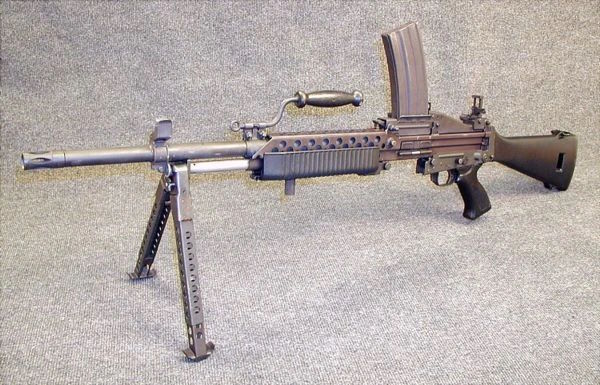
The Stoner 63A Bren is a “Bren-style” light machine gun configuration of the U.S. 5.56×45mm Stoner 63 modular weapon system designed by Eugene Stoner. It is best known for its top-mounted magazine layout (evoking the classic Bren gun handling profile) combined with the Stoner 63A’s modular receiver and quick-change configuration concept.
HISTORY
After leaving ArmaLite, Eugene Stoner developed a modular weapons system built around a common receiver with interchangeable components that could be reconfigured into multiple roles. Early prototypes were completed in 1962, and production Stoner 63 weapons in 5.56×45mm began in 1963, with Cadillac Gage as the manufacturer. U.S. testing identified reliability and durability issues, leading to an improved production standard—**Stoner 63A**—introduced in 1966.
The “Bren” configuration refers to a Stoner 63A light machine gun setup that uses a **top-mounted magazine** and is optimized for sustained automatic fire in a support role. Like the rest of the Stoner system, it was never widely standardized across U.S. forces, but the Stoner 63/63A family saw limited Vietnam-era use, most notably with U.S. Navy SEALs and in Marine evaluations. In field use, different Stoner 63A configurations could appear within small units depending on mission needs, though overall complexity, cost, and maintenance demands limited broader adoption.
Sources
- https://en.wikipedia.org/wiki/Stoner_63 Stoner 63 | Wikipedia
- https://smallarmsreview.com/the-stoner-63as-earliest-days-in-combat/ “The Stoner 63A’s Earliest Days in Combat” | Small Arms Review
- https://www.forgottenweapons.com/stoner-63a-automatic-rifle-the-original-modular-weapon/ Stoner 63A (background and context) | Forgotten Weapons
-

-
-
 Navy SEALS X-Ray Platoon. Taken on a dock near Ben Tre in Southeast Vietnam. The SEAL in the center of the group, Lt. Michael Collins, is carrying a Stoner 63A1 Mk 23 Mod 0 Commando with a short 15.7 in (398.8 mm) barrel. Lt. Michael Collins, KIA March 4th, 1971. Photo credit: US Navy.
 -

-


