Stoner 63A Commando
| Factions | Weapon | Icon | Classes | Ammo |
|---|---|---|---|---|
 US |
 Stoner 63A Commando |
 |
 Gunner Gunner |
150 / 30 |
| Damage Base | Headshot × | Chest × | Stomach × | Leg × | Arm × | Bayonet | Rifle Grenades | Reload Speed | |
|---|---|---|---|---|---|---|---|---|---|
| Partial | Empty | ||||||||
| 33 | ×2.5 = 82.5 | ×1.2 = 39.6 | ×1.15 = 37.95 | ×0.8 = 26.4 | ×0.75 = 19.8 | NO | NO | 2.66 Seconds | 3.233 Seconds |
| Designation | Weapon Type | Fire Modes | Fire Rate | Bullet Spread ° | Range Modifier | Muzzle Velocity | Projectile weight | Weight |
|---|---|---|---|---|---|---|---|---|
| Mark 23 Mod 0 | LMGs | Auto | 800 RPM | 9.43° & 2.62° ADS | 0.935 | 991 m/s | 12.3 g (189.8 gr) | 12.3 kg (27.12 lbs) |
| Full name | Caliber | Place of Origin | Date | Manufacturer | Barrel Length | Total Length | Weapon Script Name |
|---|---|---|---|---|---|---|---|
| Stoner 63A Commando | 5.56mm | USA | 1966 | Cadillac Gage Knight's Armament Company |
15.7 in (398.8 mm) | 36 in (913 mm) | weapon_stoner63 |
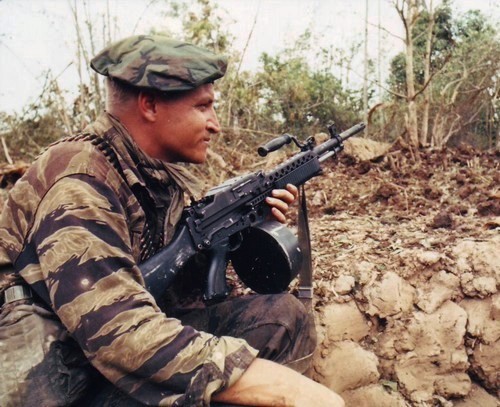
The Stoner 63A Commando is a compact “commando” configuration of the U.S. 5.56×45mm Stoner 63 modular weapon system designed by Eugene Stoner. It is best known for providing a shorter, handier Stoner 63A setup intended for special operations and close-range jungle fighting, while retaining the system’s shared receiver and modular parts commonality.
HISTORY
After leaving ArmaLite, Eugene Stoner developed a modular weapons system built around a common receiver with interchangeable components that could be reconfigured into multiple roles. Early prototypes were completed in 1962, and production Stoner 63 weapons in 5.56×45mm began in 1963, with Cadillac Gage as the manufacturer. U.S. testing found reliability and durability issues, leading to an improved production standard—**Stoner 63A**—introduced in 1966.
The **Commando** configuration was one of the shortest shoulder-fired setups in the Stoner family, intended for users who prioritized compactness and mobility. In Vietnam, the Stoner 63/63A system saw limited adoption rather than wide standardization, with U.S. Navy SEALs the most commonly documented combat users. Period photos and later historical writeups frequently associate SEAL platoons with Stoner 63A weapons in multiple configurations, including short-barrel “commando” variants carried for raids and riverine/amphibious missions. Despite strong niche appeal, overall complexity, cost, and maintenance demands limited broader issue, and the system was gradually replaced by later platforms over subsequent decades.
Sources
- https://en.wikipedia.org/wiki/Stoner_63 Stoner 63 | Wikipedia
- https://smallarmsreview.com/the-stoner-63as-earliest-days-in-combat/ “The Stoner 63A’s Earliest Days in Combat” | Small Arms Review
- https://www.forgottenweapons.com/stoner-63a-automatic-rifle-the-original-modular-weapon/ Stoner 63A (background and context) | Forgotten Weapons
-

-
-
 Navy SEALS X-Ray Platoon. Taken on a dock near Ben Tre in Southeast Vietnam. The SEAL in the center of the group, Lt. Michael Collins, is carrying a Stoner 63A1 Mk 23 Mod 0 Commando with a short 15.7 in (398.8 mm) barrel. Lt. Michael Collins, KIA March 4th, 1971. Photo credit: US Navy.
 -

-
 Navy SEALs of Foxtrot Platoon with their weapons, including multiple Stoner 63 rifles. (Photo: US Navy SEAL Museum)
 -


