Dual Baby Browning: Difference between revisions
Skizmophonic (talk | contribs) No edit summary |
Skizmophonic (talk | contribs) No edit summary |
||
| Line 9: | Line 9: | ||
! rowspan=2 | [[Ammo]] | ! rowspan=2 | [[Ammo]] | ||
|- | |- | ||
|[[File:Flag_us_new.png|50px]]<br><strong>[[US]]</strong>|| [[File:Dual Baby Browing.png|512px]]<br><b>[[Dual Baby Browning]]</b> || [[File:Weapon dual baby browning.svg|512px]] || [[ | |[[File:Flag_us_new.png|50px]]<br><strong>[[US]]</strong>|| [[File:Dual Baby Browing.png|512px]]<br><b>[[Dual Baby Browning]]</b> || [[File:Weapon dual baby browning.svg|512px]] || [[Special Loadout]]<br>[[Zombies]] || 12[[+2]] / 48 | ||
|- | |- | ||
|} | |} | ||
Latest revision as of 01:45, 4 March 2026
| Factions | Weapon | Icon | Classes | Ammo |
|---|---|---|---|---|
 US |
 Dual Baby Browning |
 |
Special Loadout Zombies |
12+2 / 48 |
| Damage Base | Headshot × | Chest × | Stomach × | Leg × | Arm × | Reload Speed | |
|---|---|---|---|---|---|---|---|
| Partial | Empty | ||||||
| 23 | ×2.6 = 59.8 | ×1.7 = 39.1 | ×1.6 = 36.8 | ×1.1 = 25.3 | ×1.05 = 24.15 | 4.233 Seconds | 6.133 Seconds |
| Designation | Weapon Type | Fire Modes | Fire Rate | Bullet Spread ° | Range Modifier | Muzzle Velocity | Projectile weight | Weight |
|---|---|---|---|---|---|---|---|---|
| FN Baby Browning | Dual Pistols | Semi | 100 RPM | 9° & 5° ADS | 0.65 | 253 m/s | 2 g (30.8 gr) | 0.550 kg (1.2 lbs) |
| Full name | Caliber | Place of Origin | Date | Manufacturer | Barrel Length | Total Length | Weapon Script Name |
|---|---|---|---|---|---|---|---|
| Fabrique Nationale Baby Browning | .25ACP | Belgium | 1931 | Fabrique Nationale de Herstal Manufacture d'armes de Bayonne |
2.11 in (53.6 mm) | 4.1 in (104 mm) | weapon_dual_baby_browning |
The FN Baby Browning is a compact Belgian semi-automatic pocket pistol chambered in .25 ACP (6.35×15mm). Designed by Dieudonné Saive and introduced in the early 1930s, it uses a simple blowback action with a 6-round magazine. It is best known for its extremely small size and for discreet carry in both civilian and specialist military contexts.
HISTORY
Fabrique Nationale’s earlier Vest Pocket pistols (marketed under several names in the 1905/1906 family) proved popular but faced heavy competition from unlicensed copies. In response, FN’s Dieudonné Saive redesigned the concept in 1926–1927 to produce a smaller, lighter successor with practical refinements, and full production began in 1931 as the Baby Browning. Over its long production life, the pistol remained a straightforward, striker-fired, blowback design optimized for concealment and close-range defensive use rather than sustained combat.
During the Vietnam War, the Baby Browning is most closely associated with deep-concealment, last-resort carry rather than general issue. Accounts of MACV-SOG equipment describe “baby” .25 pistols being carried for off-base concealment, including wallet-style holsters intended to disguise the weapon’s outline. In this niche role, the Baby Browning’s value was its extreme compactness and simplicity, even though its small cartridge limited effective range and terminal performance compared to standard service sidearms.
Sources
- Imperial War Museums — Baby Browning (collection entry)
- Smithsonian (National Museum of American History) — Baby Browning (collection entry)
- American Rifleman — “Sorting Out The Littlest Brownings”
- American Rifleman — “Behind Enemy Lines: Guns of Vietnam's SOG Warriors”
-
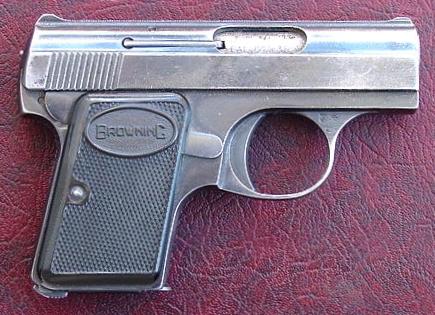 FN Baby Browning pistol.
 -
 Baby Browning, close-up.
 -
 Elvis Presley's Baby Browning (display photo).
 -
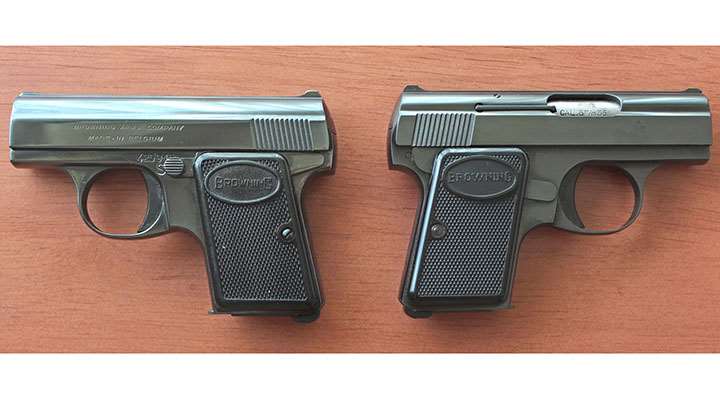 Baby Browning, detail view.
 -
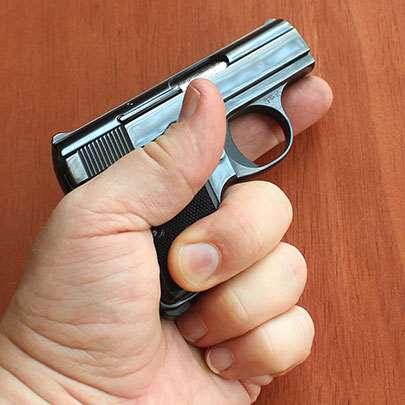 Baby Browning, detail view.
 -
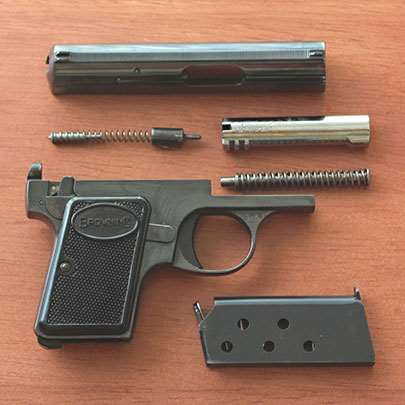 Baby Browning, detail view.


