XM177 OEG: Difference between revisions
Skizmophonic (talk | contribs) No edit summary |
Skizmophonic (talk | contribs) No edit summary |
||
| (2 intermediate revisions by the same user not shown) | |||
| Line 9: | Line 9: | ||
! rowspan=2 | [[Ammo]] | ! rowspan=2 | [[Ammo]] | ||
|- | |- | ||
|[[File:Flag_us_new.png|50px]] <br><strong>[[US]]</strong>|| [[File: | |[[File:Flag_us_new.png|50px]] <br><strong>[[US]]</strong>|| [[File:Xm177_oeg.png|512px]]<br><b> [[XM177 OEG]]</b> || [[File:Weapon xm177 oeg.png|512px]] || [[File:Class_Assault.png|50px]] <b>[[Assault]]</b><br>|| 20[[+1]]/60 | ||
|- | |- | ||
|} | |} | ||
| Line 63: | Line 63: | ||
! rowspan=2 | [[Weapon Script Name]] | ! rowspan=2 | [[Weapon Script Name]] | ||
|- | |- | ||
|FN||5.56×45mm||[[United States Of America]]|| | |FN||5.56×45mm||[[United States Of America]]||1970||ARM|| in ( mm)|| in ( mm)||weapon_xm177_oeg | ||
|} | |} | ||
<hr> | <hr> | ||
'''XM177E2''' is a compact U.S. 5.56×45mm carbine in the AR-15/M16 family, built for close-quarters handling and carried with standard M16-pattern magazines. Compared to the [[M16A1]], it uses a shorter barrel and a distinctive extended flash moderator, along with a telescoping stock. It is best known for Vietnam-era special operations use and for the characteristic “Commando” profile that influenced later U.S. carbines. | |||
==HISTORY== | |||
Colt developed the CAR-15 “Commando” series in the mid-1960s in response to U.S. military demand for a shorter M16-type weapon without the shortcomings of earlier compact AR-15 experiments. Colt engineer Rob Roy designed a simpler two-position telescoping aluminum stock to replace earlier, more complex designs, and the fragile early handguards were replaced by reinforced round handguards whose identical halves simplified parts logistics. Early Commandos existed in versions with and without a forward assist, and all were fitted with a long “moderator” muzzle device designed to reduce flash and slightly soften the report while also acting as a counterbalance on the very short barrel; this distinctive device later became a point of legal classification in the United States. | |||
The | The XM177E2 was the later Army designation for the improved Commando configuration created after field testing led Colt to lengthen the barrel from 10 inches to 11.5 inches and make related changes, including chrome-plated chambers and a modified moderator with a mounting boss intended to support the Colt [[XM148]] grenade launcher and rifle-grenade attachments. In April 1967 the U.S. Army purchased a limited quantity of these longer-barreled Commandos for specialized Vietnam service, and they were issued notably to MACV-SOG-associated personnel and other users who valued compact weapons for patrols and close-range fighting. Despite its handling advantages, period reporting also noted ongoing tradeoffs typical of early short-barreled carbines—greater blast and noise, reduced effective range and velocity compared to full-length rifles, and continued magazine availability concerns during the era—while production of the CAR-15 Commando line ended around 1970. | ||
===Sources=== | |||
* Stevens, R. Blake; Ezell, Edward C. ''The Black Rifle: M16 Retrospective''. Collector Grade Publications. | |||
* Plaster, John L. ''SOG: The Secret Wars of America’s Commandos in Vietnam''. Simon & Schuster. | |||
* Dockery, Kevin. ''Weapons of the Vietnam War''. Amber Books. | |||
* Ezell, Edward C. ''Small Arms of the World''. Stackpole Books. | |||
<hr> | <hr> | ||
<div class="mw-collapsible" style="border:1px solid #ccc; padding:5px; width:100%;"> | |||
<gallery mode="packed" heights="400px"> | <div style="text-align:center; font-weight:bold;">Real-Life Photos</div> | ||
<div class="mw-collapsible-content" style="margin-top:0.5em;"> | |||
<gallery mode="packed" heights="400px"> | |||
File:C0hl2llitva41.jpg|Reproduction | File:C0hl2llitva41.jpg|Reproduction | ||
File:Untitled a.jpg | File:Untitled a.jpg|XM177E2-style carbine. | ||
File:CAR-15555.jpg | File:CAR-15555.jpg|XM177-family CAR-15 Commando. | ||
File:Xm grip 450.jpg | File:Xm grip 450.jpg|XM177E2 grip and controls detail. | ||
File:CAR-15 (XM177E1) as tested in 1966.jpg|CAR-15 (XM177E1) as tested in 1966 | File:CAR-15 (XM177E1) as tested in 1966.jpg|CAR-15 (XM177E1) as tested in 1966 | ||
</gallery> | </gallery> | ||
</div> | |||
</div> | |||
<hr> | <hr> | ||
<div class="mw-collapsible" style="border:1px solid #ccc; padding:5px; width:100%;"> | |||
<div style="text-align:center; font-weight:bold;">Videos</div> | |||
<div class="mw-collapsible-content" style="margin-top:0.5em;"> | |||
{{#ev:youtube|po715YGEzTY}} | |||
{{#ev:youtube|qwSumviAeno}} | |||
}} | {{#ev:youtube|7ZpcSifh4JA}} | ||
</div> | |||
{{# | </div> | ||
| | |||
}} | |||
{{# | |||
| | |||
Latest revision as of 23:05, 24 February 2026
| Factions | Weapon | Icon | Classes | Ammo |
|---|---|---|---|---|
 US |
 XM177 OEG |
 |
 Assault Assault |
20+1/60 |
| Damage Base | Headshot × | Chest × | Stomach × | Leg × | Arm × | Bayonet | Rifle Grenades | Reload Speed | |
|---|---|---|---|---|---|---|---|---|---|
| Partial | Empty | ||||||||
| 35 | ×2.5 = 87.5 | ×1.2 = 42.0 | ×1.15 = 40.25 | ×0.8 = 28.0 | ×0.75 = 26.25 | NO | NO | Seconds | Seconds |
| Designation | Weapon Type | Fire Modes | Fire Rate | Bullet Spread ° | Range Modifier | Muzzle Velocity | Projectile weight | Weight |
|---|---|---|---|---|---|---|---|---|
| [[]] | Carbine | Auto+Semi | 750 RPM | 7.77° & 1.62° ADS | 0.935 | 810 m/s | 12.3 g (189.82 gr) | 2.43 kg (5.36 lbs) |
| Full name | Caliber | Place of Origin | Date | Manufacturer | Barrel Length | Total Length | Weapon Script Name |
|---|---|---|---|---|---|---|---|
| FN | 5.56×45mm | United States Of America | 1970 | ARM | in ( mm) | in ( mm) | weapon_xm177_oeg |
XM177E2 is a compact U.S. 5.56×45mm carbine in the AR-15/M16 family, built for close-quarters handling and carried with standard M16-pattern magazines. Compared to the M16A1, it uses a shorter barrel and a distinctive extended flash moderator, along with a telescoping stock. It is best known for Vietnam-era special operations use and for the characteristic “Commando” profile that influenced later U.S. carbines.
HISTORY
Colt developed the CAR-15 “Commando” series in the mid-1960s in response to U.S. military demand for a shorter M16-type weapon without the shortcomings of earlier compact AR-15 experiments. Colt engineer Rob Roy designed a simpler two-position telescoping aluminum stock to replace earlier, more complex designs, and the fragile early handguards were replaced by reinforced round handguards whose identical halves simplified parts logistics. Early Commandos existed in versions with and without a forward assist, and all were fitted with a long “moderator” muzzle device designed to reduce flash and slightly soften the report while also acting as a counterbalance on the very short barrel; this distinctive device later became a point of legal classification in the United States.
The XM177E2 was the later Army designation for the improved Commando configuration created after field testing led Colt to lengthen the barrel from 10 inches to 11.5 inches and make related changes, including chrome-plated chambers and a modified moderator with a mounting boss intended to support the Colt XM148 grenade launcher and rifle-grenade attachments. In April 1967 the U.S. Army purchased a limited quantity of these longer-barreled Commandos for specialized Vietnam service, and they were issued notably to MACV-SOG-associated personnel and other users who valued compact weapons for patrols and close-range fighting. Despite its handling advantages, period reporting also noted ongoing tradeoffs typical of early short-barreled carbines—greater blast and noise, reduced effective range and velocity compared to full-length rifles, and continued magazine availability concerns during the era—while production of the CAR-15 Commando line ended around 1970.
Sources
- Stevens, R. Blake; Ezell, Edward C. The Black Rifle: M16 Retrospective. Collector Grade Publications.
- Plaster, John L. SOG: The Secret Wars of America’s Commandos in Vietnam. Simon & Schuster.
- Dockery, Kevin. Weapons of the Vietnam War. Amber Books.
- Ezell, Edward C. Small Arms of the World. Stackpole Books.
-
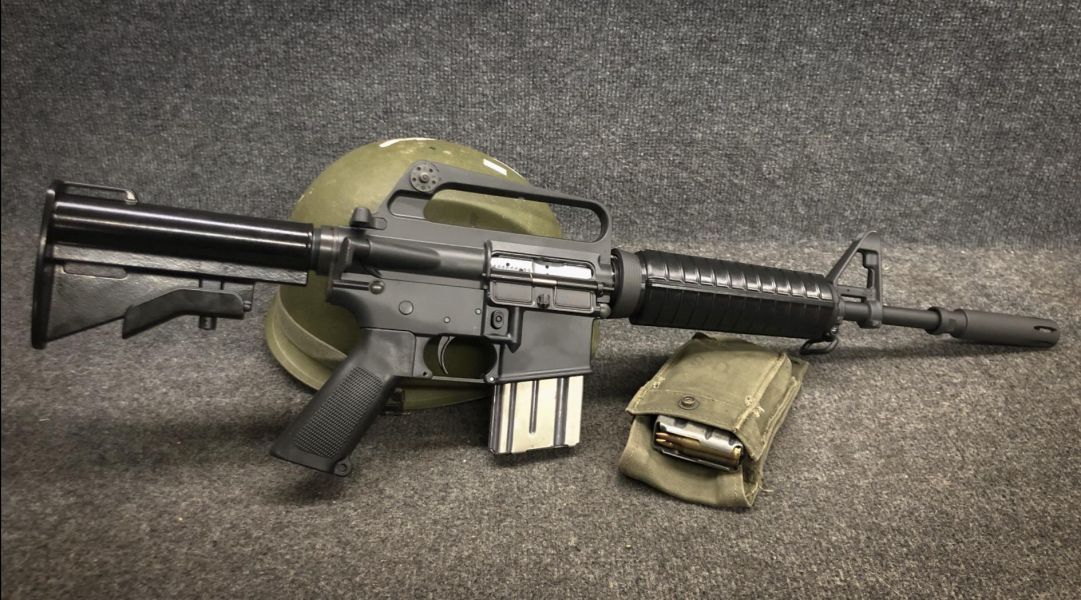 Reproduction
 -
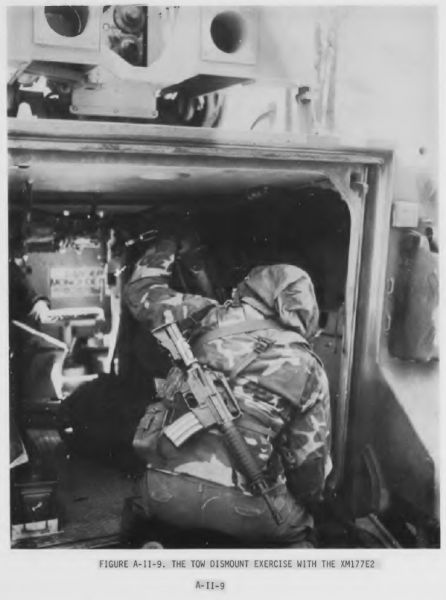 XM177E2-style carbine.
 -
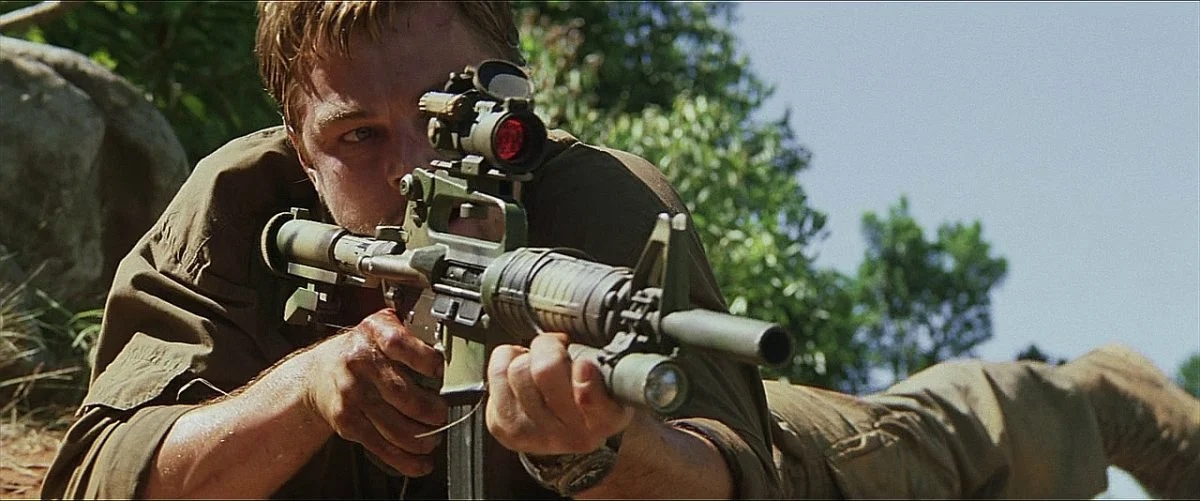 XM177-family CAR-15 Commando.
 -
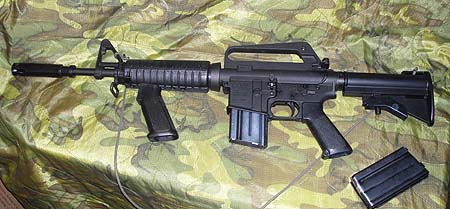 XM177E2 grip and controls detail.
 -
 CAR-15 (XM177E1) as tested in 1966


_as_tested_in_1966.jpg)