M60 Belt: Difference between revisions
Skizmophonic (talk | contribs) No edit summary |
Skizmophonic (talk | contribs) No edit summary |
||
| Line 63: | Line 63: | ||
<hr> | <hr> | ||
The M60 is | The M60 is an American general-purpose machine gun (GPMG) chambered in [[7.62×51mm NATO]] (similar in performance to .308 Winchester). It is belt-fed, air-cooled, and intended to be used from a bipod, tripod, or vehicle mounts depending on the role. The M60 is widely associated with U.S. service during the [[Vietnam War]] and is well known by its nickname “The Pig.” | ||
==HISTORY== | |||
U.S. Army development of the M60 began after World War II as part of efforts to field a lighter 7.62mm machine gun that could cover both mobile and sustained-fire roles. The final evaluation pattern was type-classified in 1957, drawing on proven concepts from wartime German weapons while incorporating U.S. design and production choices, and it entered widespread service as a replacement for older .30 caliber Brownings in many roles. In practice, the M60 could be employed as a bipod-fired squad weapon, a tripod-mounted sustained-fire gun, or mounted on vehicles, which made it flexible across units and missions. | |||
In Vietnam, the M60 became a common source of squad and platoon automatic fire, and it was also widely used on vehicles and riverine and aircraft mounts where belt-fed reliability and volume of fire were critical. Field experience highlighted both strengths and weaknesses: troops valued its handling and firepower, but heavy use in tropical conditions and high round counts could accelerate wear in key components and drive maintenance demands. Even with these issues, the M60 became one of the most recognizable U.S. machine guns of the era and remained in service in specialized roles well after newer GPMGs were adopted. | |||
===Sources=== | |||
* [https://archive.org/details/OperatorsManualForM60M122M60d U.S. Army Technical Manual (TM 9-1005-224-10): Operator’s Manual for Machine Gun, 7.62-mm, M60] | |||
* [https://goordnance.army.mil/history/M60Development.html U.S. Army Ordnance Corps: M60 Development (history overview)] | |||
* [https://www.iwm.org.uk/collections/item/object/30030071 Imperial War Museums: M60 General purpose machinegun (collection entry)] | |||
* [https://www.survivorlibrary.com/library/tm_9-1005-224-24p.pdf U.S. Army RPSTL (TM 9-1005-224-24P): M60 / M122 / M60D repair parts and tools list] | |||
<hr> | <hr> | ||
<div class="mw-collapsible" style="border:1px solid #ccc; padding:5px; width:100%;"> | |||
<gallery mode="packed" heights="400px"> | <div style="text-align:center; font-weight:bold;">Real-Life Photos</div> | ||
File:M60MG.jpg | <div class="mw-collapsible-content" style="margin-top:0.5em;"> | ||
File:Soldiers Laying Down Covering Fire.jpg | <gallery mode="packed" heights="400px"> | ||
File:M60 101st Airborne Division Exercise 1972 crop-2000x1125.jpg | File:M60MG.jpg|M60 machine gun. | ||
File:M60 2.jpg | File:Soldiers Laying Down Covering Fire.jpg|Soldiers laying down covering fire with an M60. | ||
File:M60ww.jpg | File:M60 101st Airborne Division Exercise 1972 crop-2000x1125.jpg|M60 in training with the 101st Airborne Division, 1972. | ||
File:Article-taking-the-pig-for-a-walk-history-of-the-m60-4.jpg | File:M60 2.jpg|M60 machine gun. | ||
File:615403 6 .jpg | File:M60ww.jpg|M60 machine gun. | ||
</gallery> | File:Article-taking-the-pig-for-a-walk-history-of-the-m60-4.jpg|M60 (“The Pig”) in use. | ||
File:615403 6 .jpg|M60 machine gun. | |||
</gallery> | |||
</div> | |||
</div> | |||
<hr> | <hr> | ||
<div class="mw-collapsible" style="border:1px solid #ccc; padding:5px; width:100%;"> | |||
<div style="text-align:center; font-weight:bold;">Videos</div> | |||
<div class="mw-collapsible-content" style="margin-top:0.5em;"> | |||
{{#ev:youtube|sfxdzlAYfEM}} | |||
{{#ev:youtube|uJ2LJVcuoaM}} | |||
}} | {{#ev:youtube|OTh4f7ye1IQ}} | ||
{{#ev:youtube|IVpk289nUg4}} | |||
{{# | {{#ev:youtube|HtK5gB6po_U}} | ||
{{#ev:youtube|Daez4VnB_1Q}} | |||
| | </div> | ||
</div> | |||
}} | |||
{{# | |||
| | |||
}} | |||
{{# | |||
| | |||
}} | |||
{{# | |||
| | |||
}} | |||
{{# | |||
| | |||
Latest revision as of 04:24, 25 February 2026
| Factions | Weapon | Icon | Classes | Ammo |
|---|---|---|---|---|
 US |
 M60 Belt |
 |
 Gunner Gunner |
150 / 300 |
| Damage Base | Headshot × | Chest × | Stomach × | Leg × | Arm × | Bayonet | Rifle Grenades | Reload Speed | |
|---|---|---|---|---|---|---|---|---|---|
| Partial | Empty | ||||||||
| 45 | ×2.3 = 103.5 | ×1 = 45 | ×0.95 = 42.75 | ×0.6 = 27 | ×0.55 = 24.75 | NO | NO | 5.5 Seconds | 6.166 Seconds |
| Designation | Weapon Type | Fire Modes | Fire Rate | Bullet Spread ° | Bipod Bullet Spread ° | Range Modifier | Muzzle Velocity | Projectile weight | Weight |
|---|---|---|---|---|---|---|---|---|---|
| M60 | LMG | Auto | 600 RPM | 9.23° & 2.42° ADS | 2.1° & 0.66° ADS | 0.925 | 853 m/s | 10 g (154.324 gr) | 13 kg (28.66 lbs) |
| Full name | Caliber | Place of Origin | Date | Manufacturer | Barrel Length | Total Length | Weapon Script Name |
|---|---|---|---|---|---|---|---|
| Machine Gun, Caliber 7.62 mm, M60 | 7.62x51mm | USA | 1957 | Saco Defense U.S. Ordnancem |
22.0 in (560 mm) | 43.5 in (1,105 mm) | weapon_m60b |
The M60 is an American general-purpose machine gun (GPMG) chambered in 7.62×51mm NATO (similar in performance to .308 Winchester). It is belt-fed, air-cooled, and intended to be used from a bipod, tripod, or vehicle mounts depending on the role. The M60 is widely associated with U.S. service during the Vietnam War and is well known by its nickname “The Pig.”
HISTORY
U.S. Army development of the M60 began after World War II as part of efforts to field a lighter 7.62mm machine gun that could cover both mobile and sustained-fire roles. The final evaluation pattern was type-classified in 1957, drawing on proven concepts from wartime German weapons while incorporating U.S. design and production choices, and it entered widespread service as a replacement for older .30 caliber Brownings in many roles. In practice, the M60 could be employed as a bipod-fired squad weapon, a tripod-mounted sustained-fire gun, or mounted on vehicles, which made it flexible across units and missions.
In Vietnam, the M60 became a common source of squad and platoon automatic fire, and it was also widely used on vehicles and riverine and aircraft mounts where belt-fed reliability and volume of fire were critical. Field experience highlighted both strengths and weaknesses: troops valued its handling and firepower, but heavy use in tropical conditions and high round counts could accelerate wear in key components and drive maintenance demands. Even with these issues, the M60 became one of the most recognizable U.S. machine guns of the era and remained in service in specialized roles well after newer GPMGs were adopted.
Sources
- U.S. Army Technical Manual (TM 9-1005-224-10): Operator’s Manual for Machine Gun, 7.62-mm, M60
- U.S. Army Ordnance Corps: M60 Development (history overview)
- Imperial War Museums: M60 General purpose machinegun (collection entry)
- U.S. Army RPSTL (TM 9-1005-224-24P): M60 / M122 / M60D repair parts and tools list
-
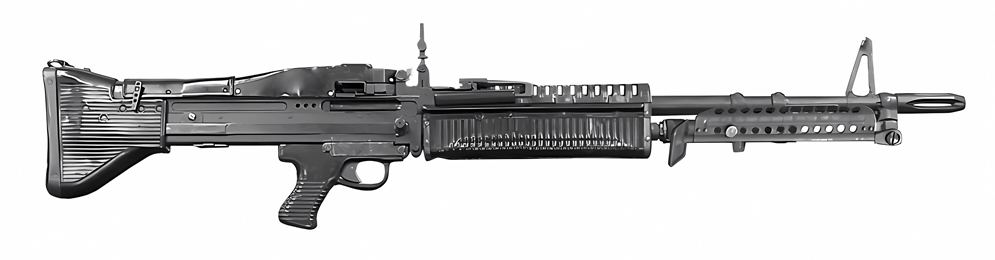 M60 machine gun.
 -
 Soldiers laying down covering fire with an M60.
 -
 M60 in training with the 101st Airborne Division, 1972.
 -
 M60 machine gun.
 -
 M60 machine gun.
 -
 M60 (“The Pig”) in use.
 -
 M60 machine gun.


