M1911A1: Difference between revisions
Skizmophonic (talk | contribs) No edit summary |
Skizmophonic (talk | contribs) No edit summary |
||
| (3 intermediate revisions by the same user not shown) | |||
| Line 9: | Line 9: | ||
! rowspan=2 | [[Ammo]] | ! rowspan=2 | [[Ammo]] | ||
|- | |- | ||
|[[File:Flag_us_new.png|50px]]<br><strong>[[US]]</strong>|| [[File:M1911.png|512px]]<br><b>[[M1911A1]]</b> || [[File:Weapon m1911.svg|512px]] || <b>Everyone Except Sniper<br> || 7[[+1]] / | |[[File:Flag_us_new.png|50px]]<br><strong>[[US]]</strong>|| [[File:M1911.png|512px]]<br><b>[[M1911A1]]</b> || [[File:Weapon m1911.svg|512px]] || <b>Everyone Except Sniper<br> || 7[[+1]] / 21 | ||
|- | |- | ||
|} | |} | ||
| Line 53: | Line 53: | ||
! rowspan=2 | [[Weapon Script Name]] | ! rowspan=2 | [[Weapon Script Name]] | ||
|- | |- | ||
|Pistol, Automatic, Caliber .45, M1911A1||.45ACP||[[USA]]|| | |Pistol, Automatic, Caliber .45, M1911A1||.45ACP||[[USA]]||1926||Colt Manufacturing Company, Smith & Wesson, Norinco, other companies||5.03 in (127 mm)||8.5 in (216 mm)||weapon_m1911 | ||
|- | |- | ||
|} | |} | ||
<hr> | <hr> | ||
The | The M1911A1 is a U.S. single-action, recoil-operated semi-automatic pistol chambered in [[.45 ACP]] (11.43×23mm). It is an updated service version of John M. Browning’s original M1911, retaining the same basic operating system while improving handling and ergonomics. The M1911A1 is best known as the long-serving American service pistol of the 20th century and for its prominent use through World War II, Korea, and the [[Vietnam War]]. | ||
==HISTORY== | |||
The M1911 emerged from U.S. military trials seeking a reliable self-loading sidearm with stopping power suitable for service use. After extensive testing in the early 1900s, Colt’s Browning-designed pistol proved exceptionally durable in trial firing and was adopted by the U.S. Army in 1911. In the 1920s, experience and user feedback led to incremental ergonomic refinements—most notably changes to the trigger length, mainspring housing shape, grip safety spur, and frame relief cuts—standardized as the M1911A1. These changes improved shootability for a wider range of hand sizes while keeping the internal mechanism and manual of arms essentially the same. | |||
During the Vietnam War, the M1911A1 remained a standard U.S. sidearm and was especially associated with roles that demanded a compact weapon, including officers, aircrew, military police, and specialized troops. It was also famously carried by “[[Tunnel Rat]]” teams who used pistols and flashlights for close-quarters tunnel searches where long guns were impractical. Although newer pistols and specialized suppressed weapons existed in limited roles, the M1911A1’s reliability, familiarity, and widespread issue kept it central to U.S. sidearm use in Vietnam-era combat. | |||
===Sources=== | |||
* [https://www.iwm.org.uk/collections/item/object/30029787 Imperial War Museums – Colt M1911A1 pistol (collection entry)] | |||
* [https://www.awm.gov.au/collection/C140438 Australian War Memorial – Colt .45 pistol, M1911A1 (collection entry)] | |||
* [https://www.battlefields.org/learn/articles/colt-m1911 National Park Service / American Battlefield Trust – Colt M1911 overview and service history] | |||
* [https://archive.org/details/TM9-1005-211-35 U.S. Army – TM 9-1005-211-35 (Field/Ordnance maintenance manual covering the caliber .45 pistol family)] | |||
<hr> | <hr> | ||
<div class="mw-collapsible" style="border:1px solid #ccc; padding:5px; width:100%;"> | |||
<gallery mode="packed" heights="400px"> | <div style="text-align:center; font-weight:bold;">Real-Life Photos</div> | ||
File:1911a1 906471l.jpg | <div class="mw-collapsible-content" style="margin-top:0.5em;"> | ||
File:M1911 and M1911A1 pistols.jpg | <gallery mode="packed" heights="400px"> | ||
File:H1193-L118908620.jpg | File:1911a1 906471l.jpg|M1911A1 pistol. | ||
File:COLT M1911A1 fieldstrip noBG 2.jpg | File:M1911 and M1911A1 pistols.jpg|M1911 and M1911A1 comparison. | ||
File:M1911A1-VIEP-spring-2023.jpg | File:H1193-L118908620.jpg|M1911A1, display photo. | ||
File:1911-vietnam-laemlein-1.jpg|A Marine radioman with his M1911 .45 ACP pistol at the ready during a search and clear mission | File:COLT M1911A1 fieldstrip noBG 2.jpg|M1911A1 field-stripped components. | ||
File:1911-vietnam-laemlein-2.jpg|The entrance to Hell: A GI of the 25th Infantry checks the entrance to a VC tunnel outside Phu Hoa Dong during Operation Cedar Falls in January | File:M1911A1-VIEP-spring-2023.jpg|M1911A1 in a Vietnam-era display context. | ||
File:1911-vietnam-laemlein-3.jpg | File:1911-vietnam-laemlein-1.jpg|A Marine radioman with his M1911 .45 ACP pistol at the ready during a search and clear mission south of Da Nang. | ||
File:1911-vietnam-laemlein-4.jpg|A “Tunnel Rat” of the 25th Infantry Division prepares to enter a VC tunnel near Cu Chi in the Hobo Woods during Operation Cedar Falls in January | File:1911-vietnam-laemlein-2.jpg|The entrance to Hell: A GI of the 25th Infantry checks the entrance to a VC tunnel outside Phu Hoa Dong during Operation Cedar Falls in January 1967. | ||
File:1911-vietnam-laemlein-5.jpg|One way out: A GI of the 1st Cavalry Division, with M1911 and flashlight in hand, looks for a helping hand out of a VC tunnel complex during Operation Pershing in March | File:1911-vietnam-laemlein-3.jpg|M1911 pistol in Vietnam. | ||
File:1911-vietnam-laemlein-4.jpg|A “Tunnel Rat” of the 25th Infantry Division prepares to enter a VC tunnel near Cu Chi in the Hobo Woods during Operation Cedar Falls in January 1967. | |||
File:1911-vietnam-laemlein-5.jpg|One way out: A GI of the 1st Cavalry Division, with M1911 and flashlight in hand, looks for a helping hand out of a VC tunnel complex during Operation Pershing in March 1967. | |||
File:1911-vietnam-laemlein-9.jpg|An ARVN soldier covers a Viet Cong prisoner with his M1911 pistol and [[M1 Garand]] rifle in 1962. | File:1911-vietnam-laemlein-9.jpg|An ARVN soldier covers a Viet Cong prisoner with his M1911 pistol and [[M1 Garand]] rifle in 1962. | ||
File:1911-vietnam-laemlein-10.jpg|The war underground: A “[[Tunnel Rat]]” descends into a VC tunnel wearing a gas mask while armed with a M1911 pistol and tremendous courage. | File:1911-vietnam-laemlein-10.jpg|The war underground: A “[[Tunnel Rat]]” descends into a VC tunnel wearing a gas mask while armed with a M1911 pistol and tremendous courage. | ||
File:1911-vietnam-laemlein-11.jpg|A Leatherneck of the 3rd Marine Division at [[Khe Sanh]] test fires his issue M1911A1 pistol along the perimeter | File:1911-vietnam-laemlein-11.jpg|A Leatherneck of the 3rd Marine Division at [[Khe Sanh]] test fires his issue M1911A1 pistol along the perimeter prior to the 1968 siege. | ||
File:Colt M1911 cross-section diagram.jpg | File:Colt M1911 cross-section diagram.jpg|Colt M1911 cross-section diagram. | ||
</gallery> | </gallery> | ||
</div> | |||
</div> | |||
<hr> | <hr> | ||
<div class="mw-collapsible" style="border:1px solid #ccc; padding:5px; width:100%;"> | |||
<div style="text-align:center; font-weight:bold;">Videos</div> | |||
<div class="mw-collapsible-content" style="margin-top:0.5em;"> | |||
{{#ev:youtube|vP8kFUgk1sU}} | |||
{{#ev:youtube|vgOicEVA4u8}} | |||
}} | {{#ev:youtube|JPYbyQmpmRc}} | ||
{{#ev:youtube|CLdiw_AHiog}} | |||
{{# | {{#ev:youtube|y2hsGZSVG4E}} | ||
{{#ev:youtube|Huk1b9PKSmw}} | |||
| | {{#ev:youtube|jP7J-JNSUu4}} | ||
</div> | |||
</div> | |||
}} | |||
{{# | |||
| | |||
}} | |||
{{# | |||
| | |||
}} | |||
{{# | |||
| | |||
}} | |||
{{# | |||
| | |||
Latest revision as of 05:58, 25 February 2026
| Factions | Weapon | Icon | Classes | Ammo |
|---|---|---|---|---|
 US |
 M1911A1 |
 |
Everyone Except Sniper |
7+1 / 21 |
| Damage Base | Headshot × | Chest × | Stomach × | Leg × | Arm × | Reload Speed | |
|---|---|---|---|---|---|---|---|
| Partial | Empty | ||||||
| 35 | ×2.6 = 91 | ×1.7 = 59.5 | ×1.6 = 56 | ×1.1 = 38.5 | ×1.05 = 36.75 | 2 Seconds | 2.3 Seconds |
| Designation | Weapon Type | Fire Modes | Fire Rate | Bullet Spread ° | Range Modifier | Muzzle Velocity | Projectile weight | Weight |
|---|---|---|---|---|---|---|---|---|
| Colt M1911 | Pistol | Semi | 50 RPM | 7° & 3° ADS | 0.7 | 253 m/s | 14.9 g (229.9 gr) | 1.105 kg (2.43 lbs) |
| Full name | Caliber | Place of Origin | Date | Manufacturer | Barrel Length | Total Length | Weapon Script Name |
|---|---|---|---|---|---|---|---|
| Pistol, Automatic, Caliber .45, M1911A1 | .45ACP | USA | 1926 | Colt Manufacturing Company, Smith & Wesson, Norinco, other companies | 5.03 in (127 mm) | 8.5 in (216 mm) | weapon_m1911 |
The M1911A1 is a U.S. single-action, recoil-operated semi-automatic pistol chambered in .45 ACP (11.43×23mm). It is an updated service version of John M. Browning’s original M1911, retaining the same basic operating system while improving handling and ergonomics. The M1911A1 is best known as the long-serving American service pistol of the 20th century and for its prominent use through World War II, Korea, and the Vietnam War.
HISTORY
The M1911 emerged from U.S. military trials seeking a reliable self-loading sidearm with stopping power suitable for service use. After extensive testing in the early 1900s, Colt’s Browning-designed pistol proved exceptionally durable in trial firing and was adopted by the U.S. Army in 1911. In the 1920s, experience and user feedback led to incremental ergonomic refinements—most notably changes to the trigger length, mainspring housing shape, grip safety spur, and frame relief cuts—standardized as the M1911A1. These changes improved shootability for a wider range of hand sizes while keeping the internal mechanism and manual of arms essentially the same.
During the Vietnam War, the M1911A1 remained a standard U.S. sidearm and was especially associated with roles that demanded a compact weapon, including officers, aircrew, military police, and specialized troops. It was also famously carried by “Tunnel Rat” teams who used pistols and flashlights for close-quarters tunnel searches where long guns were impractical. Although newer pistols and specialized suppressed weapons existed in limited roles, the M1911A1’s reliability, familiarity, and widespread issue kept it central to U.S. sidearm use in Vietnam-era combat.
Sources
- Imperial War Museums – Colt M1911A1 pistol (collection entry)
- Australian War Memorial – Colt .45 pistol, M1911A1 (collection entry)
- National Park Service / American Battlefield Trust – Colt M1911 overview and service history
- U.S. Army – TM 9-1005-211-35 (Field/Ordnance maintenance manual covering the caliber .45 pistol family)
-
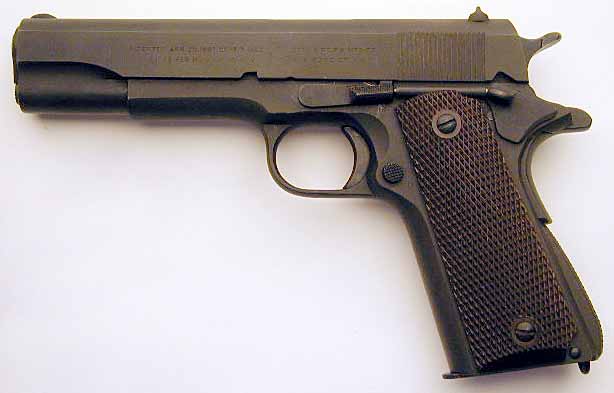 M1911A1 pistol.
 -
 M1911 and M1911A1 comparison.
 -
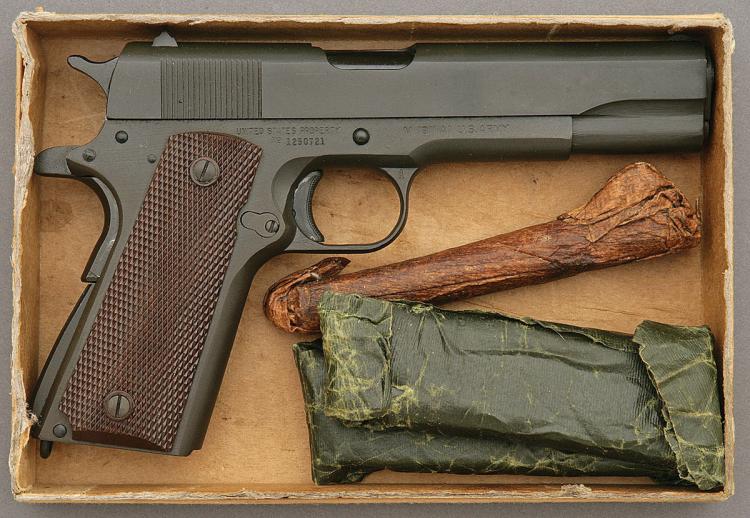 M1911A1, display photo.
 -
 M1911A1 field-stripped components.
 -
 M1911A1 in a Vietnam-era display context.
 -
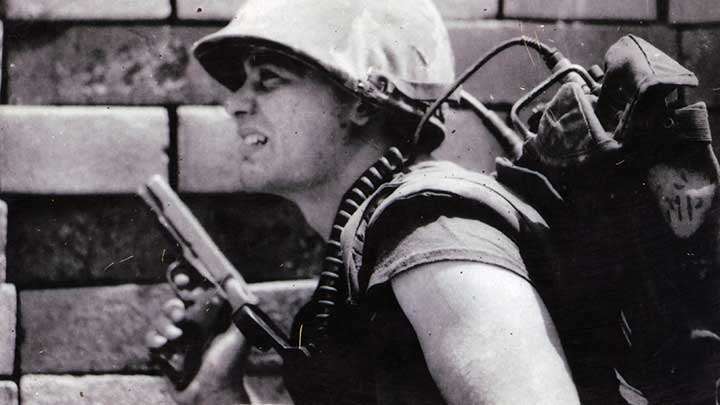 A Marine radioman with his M1911 .45 ACP pistol at the ready during a search and clear mission south of Da Nang.
 -
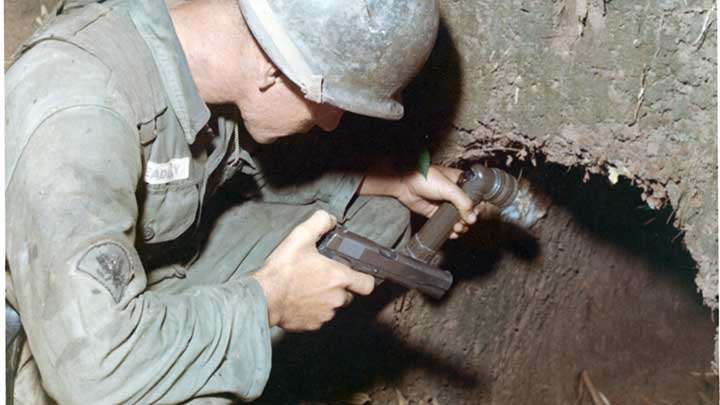 The entrance to Hell: A GI of the 25th Infantry checks the entrance to a VC tunnel outside Phu Hoa Dong during Operation Cedar Falls in January 1967.
 -
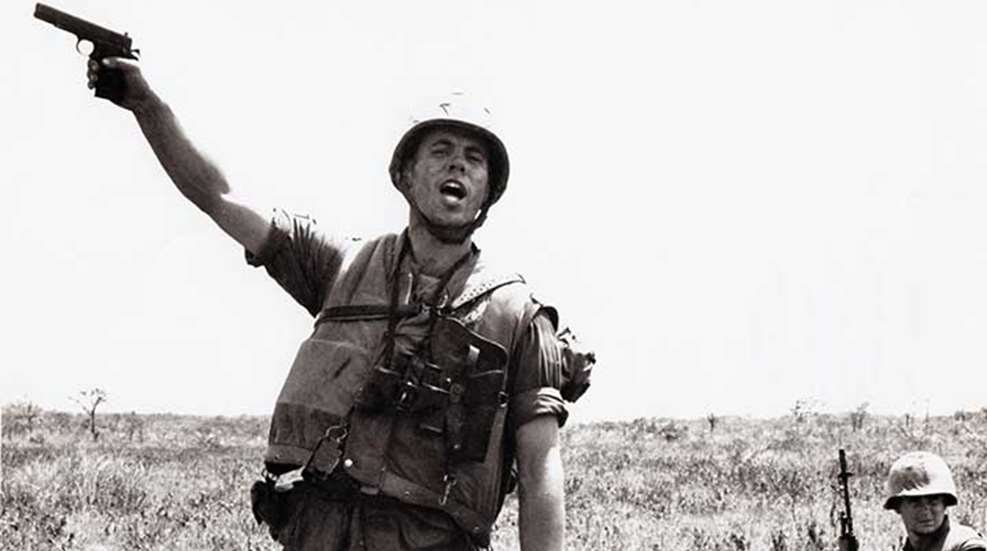 M1911 pistol in Vietnam.
 -
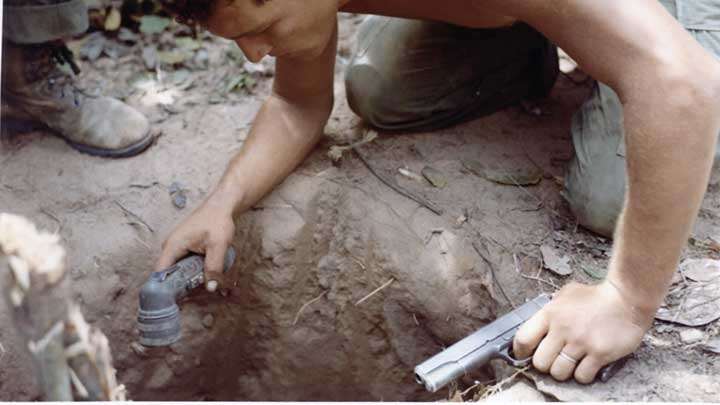 A “Tunnel Rat” of the 25th Infantry Division prepares to enter a VC tunnel near Cu Chi in the Hobo Woods during Operation Cedar Falls in January 1967.
 -
 One way out: A GI of the 1st Cavalry Division, with M1911 and flashlight in hand, looks for a helping hand out of a VC tunnel complex during Operation Pershing in March 1967.
 -
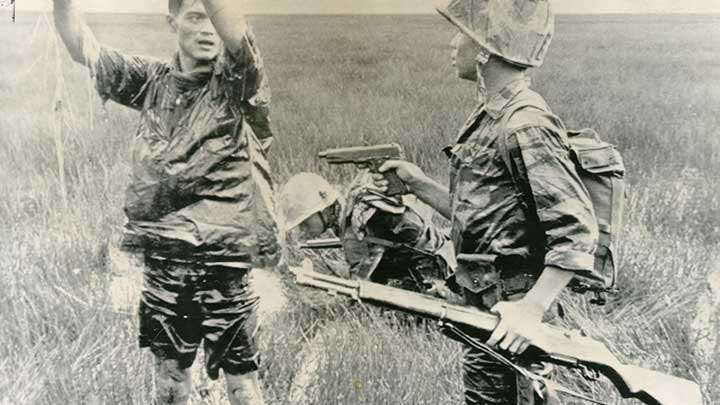 An ARVN soldier covers a Viet Cong prisoner with his M1911 pistol and M1 Garand rifle in 1962.
 -
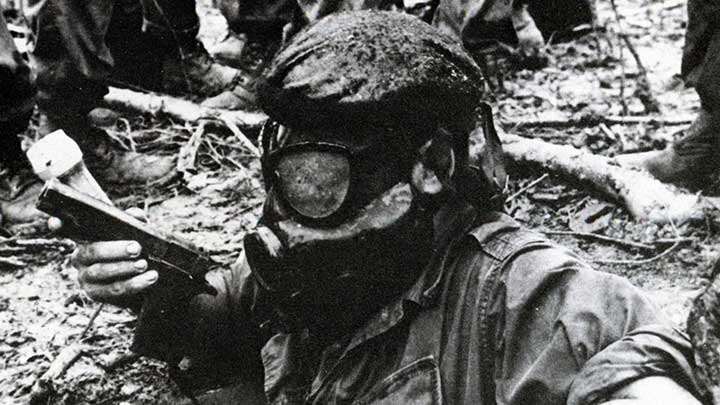 The war underground: A “Tunnel Rat” descends into a VC tunnel wearing a gas mask while armed with a M1911 pistol and tremendous courage.
 -
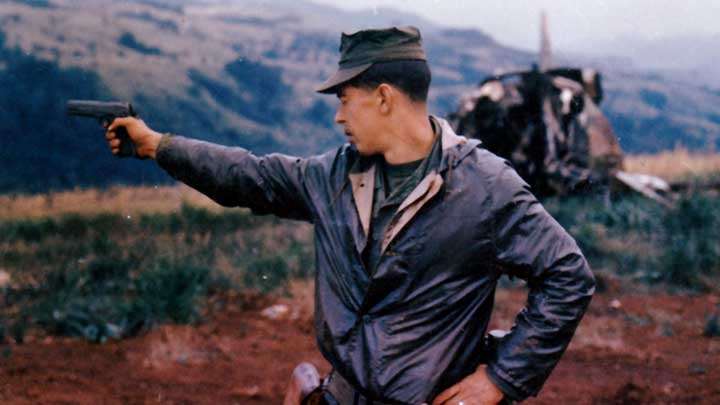 A Leatherneck of the 3rd Marine Division at Khe Sanh test fires his issue M1911A1 pistol along the perimeter prior to the 1968 siege.
 -
 Colt M1911 cross-section diagram.


