6H2 Bayonet: Difference between revisions
Skizmophonic (talk | contribs) No edit summary |
Skizmophonic (talk | contribs) No edit summary |
||
| (11 intermediate revisions by the same user not shown) | |||
| Line 1: | Line 1: | ||
[[Category:Weapons]] | |||
[[Category:Weapons of Vietnam]] | |||
{| class="wikitable sortable" style="margin:auto;text-align: center;width:90%" | {| class="wikitable sortable" style="margin:auto;text-align: center;width:90%" | ||
|- | |- | ||
| Line 6: | Line 8: | ||
! rowspan=2 | [[Weapon]] | ! rowspan=2 | [[Weapon]] | ||
! rowspan=2 | Icon | ! rowspan=2 | Icon | ||
! colspan=2 | [[Damage]] | ! colspan=2 | [[Damage]] | ||
|- | |- | ||
! | ! Primary Attack !! Secondary Attack | ||
|- | |- | ||
|- | |- | ||
|- | |- | ||
|[[File:Flag_vc_new.png|50px]]<br><strong>[[VC]]</strong>|| [[File:Ak37 bayonet.png|512px]]<br><b>[[6H2 Bayonet]]</b> || [[File:Weapon ak47_bayonet.svg|512px]] | |[[File:Flag_vc_new.png|50px]]<br><strong>[[VC]]</strong>|| [[File:Ak37 bayonet.png|512px]]<br><b>[[6H2 Bayonet]]</b> || [[File:Weapon ak47_bayonet.svg|512px]] || 35<br>52 headshot || 55 (25 bleed) | ||
|- | |- | ||
|} | |} | ||
| Line 22: | Line 23: | ||
! rowspan=2 | [[Place of Origin]] | ! rowspan=2 | [[Place of Origin]] | ||
! rowspan=2 | [[Date]] | ! rowspan=2 | [[Date]] | ||
! rowspan=2 | [[ | ! rowspan=2 | [[Manufacturer]] | ||
! rowspan=2 | Blade Length | ! rowspan=2 | Blade Length | ||
! rowspan=2 | Total Length | ! rowspan=2 | Total Length | ||
! rowspan=2 | [[Weapon Script Name]] | ! rowspan=2 | [[Weapon Script Name]] | ||
|- | |- | ||
| | |6H2 Bayonet||[[Melee]]||[[Soviet Union]]||1955||Izhevsk Arsenal||7.9 in (200 mm)||15.2 in (387 mm)||weapon_ak47_bayonet | ||
|- | |- | ||
|} | |} | ||
| Line 33: | Line 34: | ||
<hr> | <hr> | ||
The [[AK-47]] | The 6H2 (6Kh2 / 6X2) is the first standardized knife bayonet pattern issued for the early [[AK-47]] series rifles. It features a spear-point blade and a distinctive mounting system intended for AK rifles originally produced without bayonet fittings. The 6H2 is best known as the predecessor to later AK bayonet-knife models that added multi-purpose features such as wire-cutting. | ||
==HISTORY== | |||
The 6H2 entered Soviet service in the mid-1950s as a response to renewed emphasis on bayonet capability after early AK production runs had been issued without a bayonet interface. Contemporary technical histories describe it being adopted alongside the “lightened” AK variant in 1955 and produced through about 1960, with manufacture at Izhmash (Izhevsk). Its blade profile followed the general form of the SKS blade bayonet but in a shorter, detachable knife-bayonet format suitable for the AK’s revised mounting points. | |||
The 6H2 was soon replaced in frontline issue by newer AK bayonet patterns (beginning with the 6H3) that expanded functionality and improved compatibility with later Kalashnikov rifle variants. While the 6H2 itself is associated primarily with early Soviet AK rifles, bayonets for AK-pattern weapons were present in Southeast Asia through the widespread fielding of AK and AK-derived rifles during the [[Vietnam War]]. Captured examples of AK-pattern bayonets from the conflict are preserved in museum collections, reflecting their real battlefield use even as specific bayonet patterns varied by origin and rifle model. | |||
===Sources=== | |||
* [https://www.kalashnikov.ru/evolyutsiya-shtyka-shtyk-nozhi-6h2-6h3-6h4-i-6h5-dlya-avtomatov-kalalashnikova/ Оружейный журнал «КАЛАШНИКОВ» — «Эволюция штыка. Штык-ножи 6Х2, 6Х3, 6Х4 и 6Х5…»] | |||
< | * [https://www.awm.gov.au/collection/C1234417 Australian War Memorial — Type 56 (AK47) spike bayonet (Vietnam, 1962–1975)] | ||
* [https://archive.org/download/Weapons_an_International_Encyclopedia_from_5000_BC_to_2000_AD_the_Diagram_Group/Weapons_an_International_Encyclopedia_from_5000_BC_to_2000_AD_the_Diagram_Group_djvu.txt The Diagram Group — ''Weapons: An International Encyclopedia from 5000 BC to 2000 AD''] | |||
<hr> | |||
<div class="mw-collapsible" style="border:1px solid #ccc; padding:5px; width:100%;"> | |||
<div style="text-align:center; font-weight:bold;">Real-Life Photos</div> | |||
<div class="mw-collapsible-content" style="margin-top:0.5em;"> | |||
<gallery mode="packed" heights="400px"> | |||
File:6h2 aaa.jpg|6H2 bayonet and scabbard. | |||
File:6h2 aab.jpg|6H2 bayonet, close-up. | |||
File:6h2 aad.jpg|6H2 bayonet, side profile. | |||
File:B1411-1.jpg|6H2 bayonet with scabbard and hanger. | |||
File:First-Pattern-Soviet-AK-47-Bayonet-Type-6X2-1955-1960-3-scaled.jpg|First-pattern Soviet AK bayonet (6H2/6X2), 1955–1960. | |||
File:First-Pattern-Soviet-AK-47-Bayonet-Type-6X2-1955-1960-2-scaled.jpg|First-pattern Soviet AK bayonet (6H2/6X2), alternate view. | |||
File:History-of-AK-Bayonets-in-Soviet-Union-and-Russia-6X2-1.jpg|6H2/6X2 shown in an AK bayonet history reference image. | |||
</gallery> | |||
</div> | |||
</div> | |||
<hr> | <hr> | ||
<div class="mw-collapsible" style="border:1px solid #ccc; padding:5px; width:100%;"> | |||
<div style="text-align:center; font-weight:bold;">Videos</div> | |||
<div class="mw-collapsible-content" style="margin-top:0.5em;"> | |||
{{#ev:youtube|-5RPD5uu-ZY}} | |||
{{#ev:youtube|maKGmJ1kYbE}} | |||
{{#ev:youtube|86wCIDJVHvA}} | |||
}} | </div> | ||
</div> | |||
{{# | |||
| | |||
}} | |||
{{# | |||
| | |||
Latest revision as of 04:55, 25 February 2026
| Factions | Weapon | Icon | Damage | |
|---|---|---|---|---|
| Primary Attack | Secondary Attack | |||
 VC |
 6H2 Bayonet |
 |
35 52 headshot |
55 (25 bleed) |
| Full name | Weapon Type | Place of Origin | Date | Manufacturer | Blade Length | Total Length | Weapon Script Name |
|---|---|---|---|---|---|---|---|
| 6H2 Bayonet | Melee | Soviet Union | 1955 | Izhevsk Arsenal | 7.9 in (200 mm) | 15.2 in (387 mm) | weapon_ak47_bayonet |
The 6H2 (6Kh2 / 6X2) is the first standardized knife bayonet pattern issued for the early AK-47 series rifles. It features a spear-point blade and a distinctive mounting system intended for AK rifles originally produced without bayonet fittings. The 6H2 is best known as the predecessor to later AK bayonet-knife models that added multi-purpose features such as wire-cutting.
HISTORY
The 6H2 entered Soviet service in the mid-1950s as a response to renewed emphasis on bayonet capability after early AK production runs had been issued without a bayonet interface. Contemporary technical histories describe it being adopted alongside the “lightened” AK variant in 1955 and produced through about 1960, with manufacture at Izhmash (Izhevsk). Its blade profile followed the general form of the SKS blade bayonet but in a shorter, detachable knife-bayonet format suitable for the AK’s revised mounting points.
The 6H2 was soon replaced in frontline issue by newer AK bayonet patterns (beginning with the 6H3) that expanded functionality and improved compatibility with later Kalashnikov rifle variants. While the 6H2 itself is associated primarily with early Soviet AK rifles, bayonets for AK-pattern weapons were present in Southeast Asia through the widespread fielding of AK and AK-derived rifles during the Vietnam War. Captured examples of AK-pattern bayonets from the conflict are preserved in museum collections, reflecting their real battlefield use even as specific bayonet patterns varied by origin and rifle model.
Sources
- Оружейный журнал «КАЛАШНИКОВ» — «Эволюция штыка. Штык-ножи 6Х2, 6Х3, 6Х4 и 6Х5…»
- Australian War Memorial — Type 56 (AK47) spike bayonet (Vietnam, 1962–1975)
- The Diagram Group — Weapons: An International Encyclopedia from 5000 BC to 2000 AD
-
 6H2 bayonet and scabbard.
 -
 6H2 bayonet, close-up.
 -
 6H2 bayonet, side profile.
 -
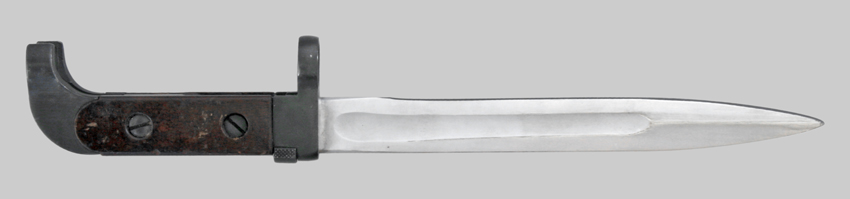 6H2 bayonet with scabbard and hanger.
 -
 First-pattern Soviet AK bayonet (6H2/6X2), 1955–1960.
 -
 First-pattern Soviet AK bayonet (6H2/6X2), alternate view.
 -
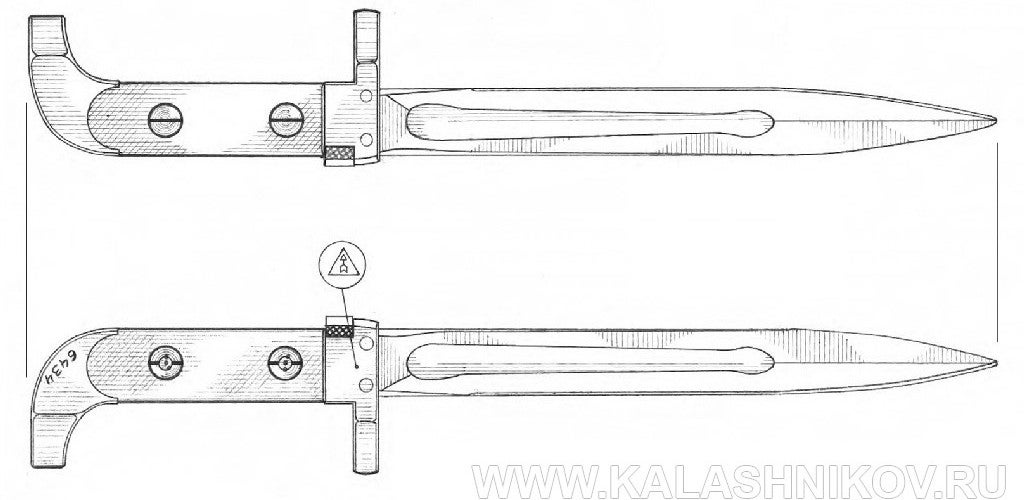 6H2/6X2 shown in an AK bayonet history reference image.


