TT-33: Difference between revisions
Skizmophonic (talk | contribs) No edit summary |
Skizmophonic (talk | contribs) No edit summary |
||
| Line 56: | Line 56: | ||
|- | |- | ||
|} | |} | ||
Revision as of 06:18, 25 February 2026
| Factions | Weapon | Icon | Classes | Ammo |
|---|---|---|---|---|
 VC |
 TT-33 |
 |
Everyone Except Sniper |
8+1 / 24 |
| Damage Base | Headshot × | Chest × | Stomach × | Leg × | Arm × | Reload Speed | |
|---|---|---|---|---|---|---|---|
| Partial | Empty | ||||||
| 35 | ×2.6 = 91 | ×1.7 = 59.5 | ×1.6 = 56 | ×1.1 = 38.5 | ×1.05 = 36.75 | 2 Seconds | 2.33 Seconds |
| Designation | Weapon Type | Fire Modes | Fire Rate | Bullet Spread ° | Range Modifier | Muzzle Velocity | Projectile weight | Weight |
|---|---|---|---|---|---|---|---|---|
| TT-33 | Pistol | Semi | 50 RPM | 7.0° & 3.0° ADS | 0.7 | 450 m/s | 5.5 g (84.87 gr) | 0.854 kg (1.88 lbs) |
| Full name | Caliber | Place of Origin | Date | Manufacturer | Barrel Length | Total Length | Weapon Script Name |
|---|---|---|---|---|---|---|---|
| Tula Tokarev-33 | 7.62x25 | Soviet Union | 1930 | Tula Arms Plant, Izhevsk Arsenal, Norinco, Femaru, FB Radom, Cugir Arsenal, Zastava Arms, FÉG | 4.6 in (116 mm) | 7.7 in (195 mm) | weapon_tt33 |
The TT-33 (Tokarev) is a Soviet semi-automatic service pistol chambered in 7.62×25mm Tokarev. It is a short-recoil, locked-breech design that shares several concepts with earlier Browning-pattern pistols while emphasizing simplified manufacture and rugged military handling. The TT-33 is best known for its high-velocity cartridge, flat trajectory, and widespread Cold War distribution through Soviet allies and licensed production.
HISTORY
In the early 1930s the Soviet Union sought a replacement for the Nagant M1895 revolver, leading to trials of new semi-automatic pistols. Fedor Tokarev’s early TT-30 pattern was adopted and then simplified for mass production, resulting in the TT-33 with fewer parts and changes to the lockwork and barrel/slide interface. The pistol retained Browning-style short recoil operation with a tilting barrel, but used a modular hammer/sear group to streamline production and field servicing, and it became a standard sidearm for Soviet forces through World War II.
After the war, the TT-33 remained in service for years and was widely exported and produced abroad, especially in the People’s Republic of China and other Soviet-aligned states. In Southeast Asia, Tokarev pistols and Chinese copies appeared through Cold War aid and capture, and examples were encountered during the Vietnam War era among the varied sidearms in circulation. Although the TT-33 was eventually replaced in Soviet service by the Makarov PM, its powerful cartridge and extensive worldwide production kept the platform and its derivatives in use for decades.
Sources
- Imperial War Museums — TT-33 Tokarev pistol (collection entry)
- Royal Armouries — Tokarev TT-33 pistol (collection entry)
- Smithsonian (National Museum of American History) — Tokarev pistol (collection entry)
- Ian V. Hogg, Pistols of the World (Krause Publications)
-
 TT-33 Tokarev pistol.
 -
 TT-33, profile view.
 -
 TT-33, detail view.
 -
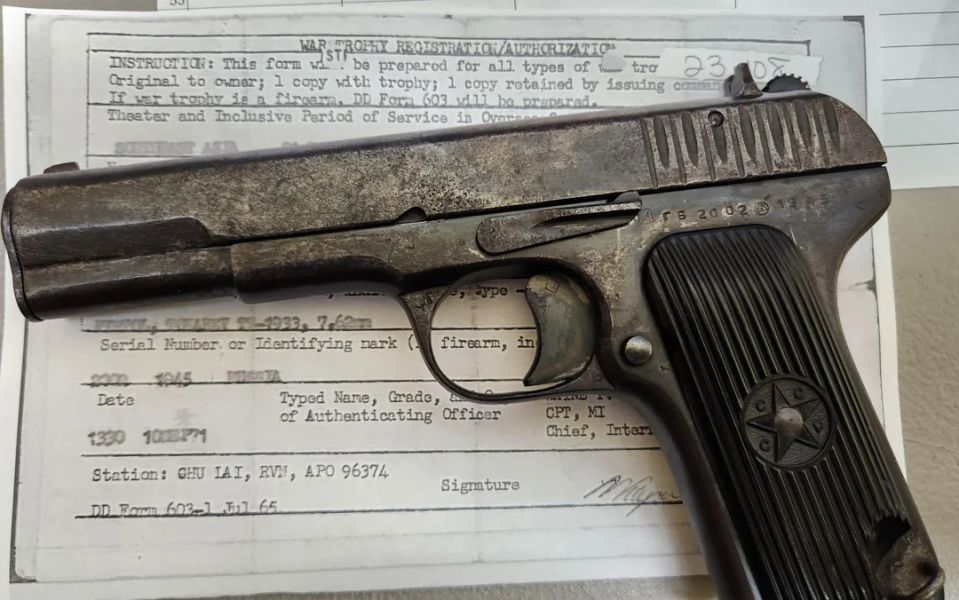 TT-33 (example photo; claimed Vietnam War trophy).
 -
 Vietnam-era bring-back TT-33 (example photo).
 -
 TT-33 pistol, close-up.


