XM607 OEG: Difference between revisions
Skizmophonic (talk | contribs) No edit summary |
Skizmophonic (talk | contribs) No edit summary |
||
| Line 60: | Line 60: | ||
<hr> | |||
'''XM607''' (Colt Model 607) is an early compact AR-15/M16-family carbine developed by Colt, chambered in 5.56×45mm. It used a very short barrel and an early retractable stock design to minimize overall length for special operations and vehicle use. It is best known as one of the first “CAR-15” short carbines and for the distinctive early telescoping stock and muzzle-moderator experiments that influenced later Commando models. | |||
==HISTORY== | |||
Colt’s first compact AR-15 experiments began in the late 1950s with the “Tanker” style retractable-stock concept, and in 1965 Colt introduced the Model 607 CAR-15 “Submachine Gun” as an improved version with some features drawn from the emerging M16 family. Although chambered for rifle ammunition, Colt used “submachine gun” terminology to emphasize the weapon’s compactness compared to longer carbines. The Model 607 used a very short barrel (too short for a bayonet lug) and a distinctive two-position retractable stock that resembled a shortened fixed stock, with a recessed latch allowing extension to increase length of pull. Production was limited—often cited at roughly a few dozen weapons—and many examples were assembled from available parts rather than as a fully standardized production run; early builds used AR-15/M16-pattern receivers without a forward assist and shortened grips, while later Model 607A configurations used XM16E1-style receivers with forward assist and standard grips. The handguards were also improvised by cutting down full-length rifle handguards to fit the shortened front end. | |||
The extremely short barrel produced a loud report and bright muzzle flash, driving several muzzle-device experiments. Early guns used standard three-prong “duckbill” style flash hiders with limited effect, and by 1966 Colt introduced dedicated “moderator” devices intended to reduce flash and slightly soften the blast while also increasing back pressure for reliability. The shorter 3.5-inch moderator was followed by the better-known 4.25-inch slotted moderator with an expansion chamber that became standard for later compact CAR-15/Commando patterns, though heavy fouling and tracer instability issues were reported to persist. Experience with the Model 607’s handling, stock design, and muzzle devices fed directly into the later XM177/Commando line that saw broader Vietnam-era adoption. | |||
===Sources=== | |||
* Stevens, R. Blake; Ezell, Edward C. ''The Black Rifle: M16 Retrospective''. Collector Grade Publications. | |||
* Ezell, Edward C. ''Small Arms of the World''. Stackpole Books. | |||
* Dockery, Kevin. ''Weapons of the Vietnam War''. Amber Books. | |||
* Plaster, John L. ''SOG: The Secret Wars of America’s Commandos in Vietnam''. Simon & Schuster. | |||
<hr> | <hr> | ||
<div class="mw-collapsible" style="border:1px solid #ccc; padding:5px; width:100%;"> | |||
<gallery mode="packed" heights="400px"> | <div style="text-align:center; font-weight:bold;">Real-Life Photos</div> | ||
<div class="mw-collapsible-content" style="margin-top:0.5em;"> | |||
<gallery mode="packed" heights="400px"> | |||
File:Xm607-stocks-v0-v0j2d3o15j8c1.jpg|Reproduction | File:Xm607-stocks-v0-v0j2d3o15j8c1.jpg|Reproduction | ||
File:XM607 assault carbine.JPG | File:XM607 assault carbine.JPG|XM607 / Colt Model 607-style carbine. | ||
File:7pRdviLEBmD05wKZbHaIkSEbo01YZiDg-2216pFsndA.jpg | File:7pRdviLEBmD05wKZbHaIkSEbo01YZiDg-2216pFsndA.jpg|Early CAR-15 / Model 607 configuration. | ||
File:607-1-sm-743x264.jpg | File:607-1-sm-743x264.jpg|Model 607 family profile. | ||
</gallery> | |||
</gallery> | </div> | ||
</div> | |||
<hr> | <hr> | ||
<div class="mw-collapsible" style="border:1px solid #ccc; padding:5px; width:100%;"> | |||
<div style="text-align:center; font-weight:bold;">Videos</div> | |||
<div class="mw-collapsible-content" style="margin-top:0.5em;"> | |||
{{#ev:youtube|ajQhLYgohGM}} | |||
</div> | |||
</div> | |||
Revision as of 23:07, 24 February 2026
| Factions | Weapon | Icon | Classes | Ammo |
|---|---|---|---|---|
 US |
 XM607 OEG |
 |
 Assault Assault |
20+1 / 60 |
| Damage Base | Headshot × | Chest × | Stomach × | Leg × | Arm × | Bayonet | Rifle Grenades | Reload Speed | |
|---|---|---|---|---|---|---|---|---|---|
| Partial | Empty | ||||||||
| 35 | ×2.5 = 87.5 | ×1.2 = 42 | ×1.15 = 40.25 | ×0.8 = 28 | ×0.75 = 26.25 | NO | NO | 2.366 Seconds | 3.166 Seconds |
| Designation | Weapon Type | Fire Modes | Fire Rate | Bullet Spread ° | Range Modifier | Muzzle Velocity | Projectile weight | Weight |
|---|---|---|---|---|---|---|---|---|
| XM607 | Carbine | Auto+Semi | 750 RPM | 7.77° & 1.62° ADS | 0.935 | 810 m/s | 12.3 g (190 gr) | 2.43 kg (5.35 lbs) |
| Full name | Caliber | Place of Origin | Date | Manufacturer | Barrel Length | Total Length | Weapon Script Name |
|---|---|---|---|---|---|---|---|
| CAR-15 Model 607 | 5.56mm | USA | 1970 | Colt | 13.5 in (343 mm) | 32.5 in (830 mm) | weapon_m607_oeg |
XM607 (Colt Model 607) is an early compact AR-15/M16-family carbine developed by Colt, chambered in 5.56×45mm. It used a very short barrel and an early retractable stock design to minimize overall length for special operations and vehicle use. It is best known as one of the first “CAR-15” short carbines and for the distinctive early telescoping stock and muzzle-moderator experiments that influenced later Commando models.
HISTORY
Colt’s first compact AR-15 experiments began in the late 1950s with the “Tanker” style retractable-stock concept, and in 1965 Colt introduced the Model 607 CAR-15 “Submachine Gun” as an improved version with some features drawn from the emerging M16 family. Although chambered for rifle ammunition, Colt used “submachine gun” terminology to emphasize the weapon’s compactness compared to longer carbines. The Model 607 used a very short barrel (too short for a bayonet lug) and a distinctive two-position retractable stock that resembled a shortened fixed stock, with a recessed latch allowing extension to increase length of pull. Production was limited—often cited at roughly a few dozen weapons—and many examples were assembled from available parts rather than as a fully standardized production run; early builds used AR-15/M16-pattern receivers without a forward assist and shortened grips, while later Model 607A configurations used XM16E1-style receivers with forward assist and standard grips. The handguards were also improvised by cutting down full-length rifle handguards to fit the shortened front end.
The extremely short barrel produced a loud report and bright muzzle flash, driving several muzzle-device experiments. Early guns used standard three-prong “duckbill” style flash hiders with limited effect, and by 1966 Colt introduced dedicated “moderator” devices intended to reduce flash and slightly soften the blast while also increasing back pressure for reliability. The shorter 3.5-inch moderator was followed by the better-known 4.25-inch slotted moderator with an expansion chamber that became standard for later compact CAR-15/Commando patterns, though heavy fouling and tracer instability issues were reported to persist. Experience with the Model 607’s handling, stock design, and muzzle devices fed directly into the later XM177/Commando line that saw broader Vietnam-era adoption.
Sources
- Stevens, R. Blake; Ezell, Edward C. The Black Rifle: M16 Retrospective. Collector Grade Publications.
- Ezell, Edward C. Small Arms of the World. Stackpole Books.
- Dockery, Kevin. Weapons of the Vietnam War. Amber Books.
- Plaster, John L. SOG: The Secret Wars of America’s Commandos in Vietnam. Simon & Schuster.
-
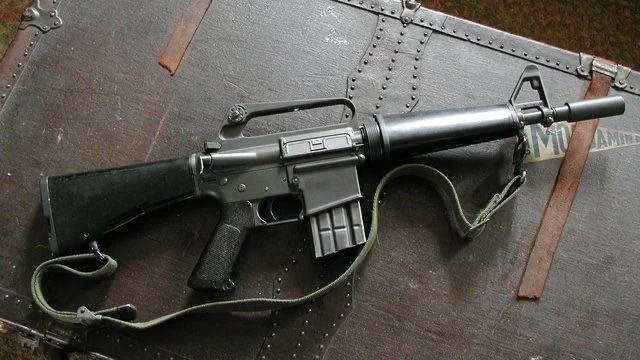 Reproduction
 -
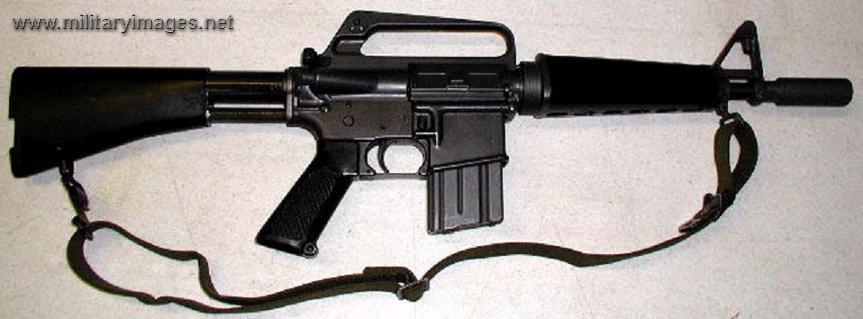 XM607 / Colt Model 607-style carbine.
 -
 Early CAR-15 / Model 607 configuration.
 -
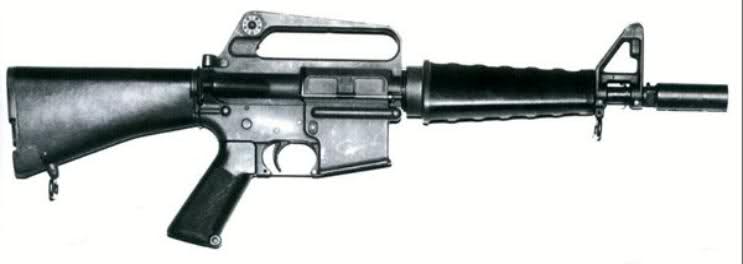 Model 607 family profile.


