M6A1 Gas
| Factions | Weapon | Icon | Classes | Ammo | Explosion | |
|---|---|---|---|---|---|---|
| Damage | Radius | |||||
 US |
 M6A1 Gas |
 |
 Assault Assault |
1 / 2 | 5 per sec | 5 meters |
| Designation | Weapon Type | Fire Modes | Throwing Range | Weight |
|---|---|---|---|---|
| [[]] | Special Grenades | Overhand Underhand |
25 meters? | kg (lbs) |
| Full name | Ammo Type | Place of Origin | Date | Manufacturer | Total Length | Weapon Script Name |
|---|---|---|---|---|---|---|
| FN | AT | PoO | D8 | Arm | in (mm) | weapon_m6a1 |
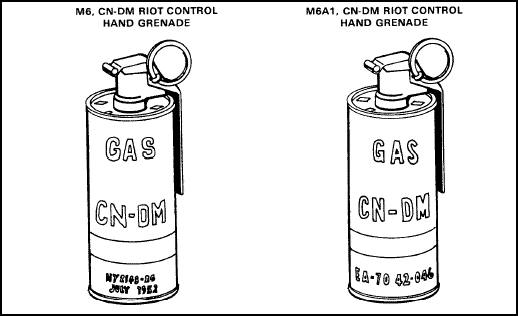
The M6A1 Gas is a U.S. CN-DM irritant (riot-control) hand grenade designed to produce a dense cloud of irritating agent smoke rather than fragmentation. It combines CN (tear gas) and DM (an irritant sometimes described as a vomiting agent) and uses a burning-type fill that vents through emission holes in the grenade body. It is best known as a Vietnam-era U.S. “gas” grenade for area denial and clearing enclosed positions, where friendly forces could mask up and force an enemy to move.
HISTORY
The M6A1 was standardized as an improved CN-DM irritant grenade in the 1950s, broadly similar in size and shape to the earlier M6 but differing in how the filler is packaged and how the body vents smoke. Technical descriptions note that the M6A1’s CN and DM are pressed into separate metal cups so they are not in contact before ignition, and the sheet-metal body uses four emission holes at the top and one at the bottom, sealed with tape to protect against moisture. It is ignited by the M201A1 fuze and can be thrown by hand or projected from a rifle or carbine using an M2A1 grenade projection adapter; U.S. Army references describe a typical throw of about 35 meters and an emission duration of roughly 20–60 seconds.
In U.S. doctrine, CN/DM grenades were categorized as riot-control/irritant munitions intended for tactical missions where smoke-like chemical effects were useful, with manuals emphasizing that friendly troops should don protective masks before employment. Because it relies on generating an irritant cloud through burning filler rather than bursting fragmentation, the M6A1 was suited to denying small areas, disrupting occupants of cover, and clearing confined spaces when used with appropriate protective measures.
Sources
- https://www.bulletpicker.com/pdf/TB-3-300-4.pdf TB 3-300-4: Grenade, Hand, Irritant, CN-DM, M6A1 (1958) | Department of the Army (PDF)
- https://www.bits.de/NRANEU/others/amd-us-archive/FM3-23.30%2800%29.pdf FM 3-23.30: Grenades and Pyrotechnic Signals (Appendix E: M6/M6A1 data) | Department of the Army (PDF)
- https://www.globalsecurity.org/military/library/policy/army/fm/3-23-30/appe.htm FM 3-23.30 Appendix E (M6/M6A1 summary) | GlobalSecurity.org
-
 Cutaway diagram of the M6A1 CN-DM irritant grenade.
